
Have you ever heard of shaftless elevators in your daily life?
A type of lifting equipment that is an improvement or replacement for traditional shafted elevators. Its features include: no need for civil engineering shafts, no pit, and no machine room for installation. Therefore, if you are renovating an old house, upgrading a villa, or have limited mobility or space, a shaftless elevator is the best choice. Compared to traditional elevators, it saves more space, is easier and faster to install, and does not damage the original decoration, pipelines, or layout. Furthermore, installing a lifting device in a residence makes entry and exit easier, providing a convenient, comfortable, and efficient solution.
Currently, shaftless lifting equipment on the market is mainly divided into four types. The following article will introduce their structural features, advantages and disadvantages, and applicable scenarios to help you make the right choice.
The Types of Shaftless Lift for Homes
For shaftless lifting equipment for home, the main types are:Shaftless, Through-the-Floor Home Elevator,Stairlift, Unenclosed Vertical Wheelchair Lift, Incline Platform Lift.
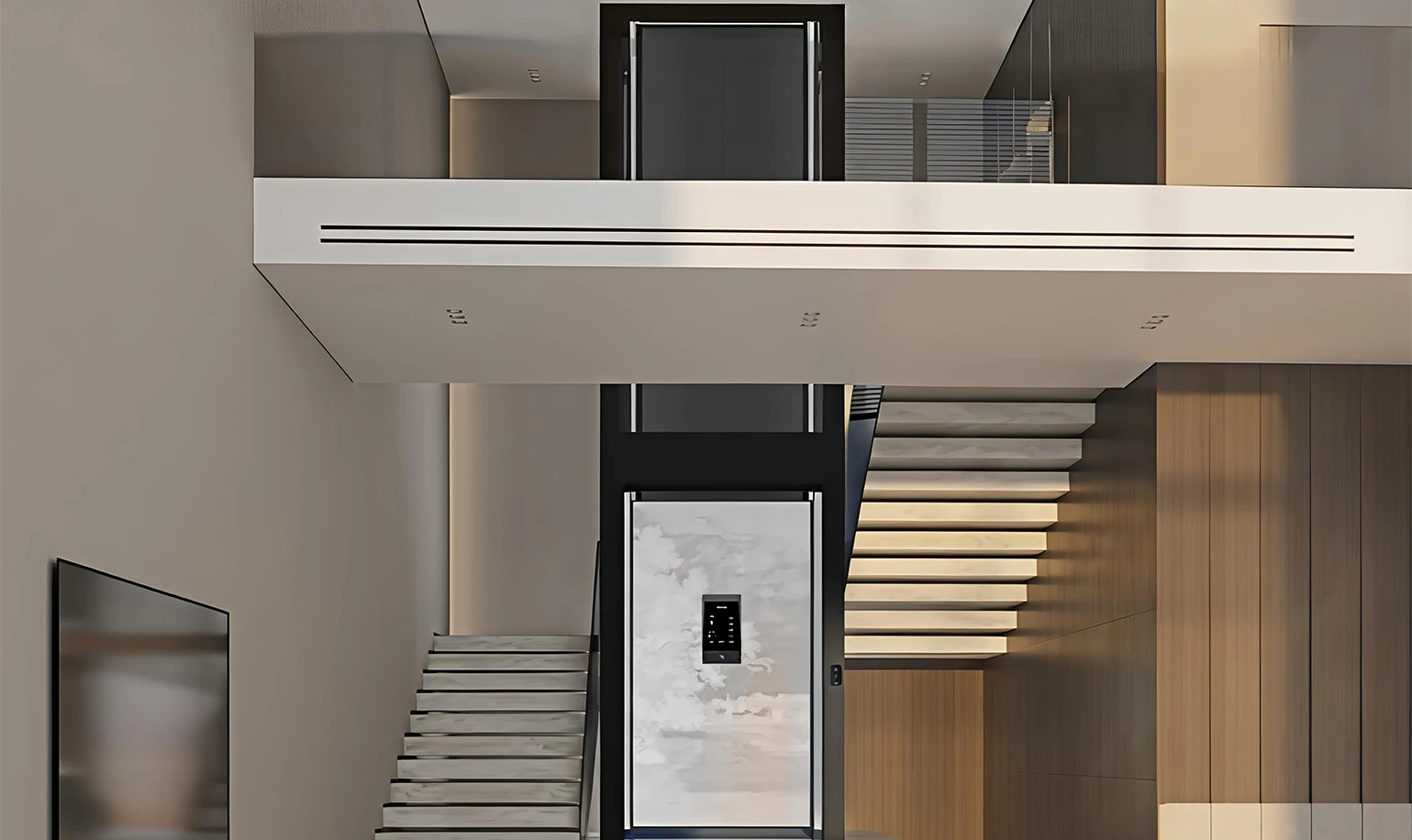
Shaftless, Through-the-Floor Home Elevator
The shaftless through-the-floor home elevator comes with its own support frame, eliminating the need for brick walls or concrete/steel structure enclosures. This type of home elevator can be installed anywhere in a house without relying on a wall; simply leave a circular or square opening of the same size on each floor.
The shaftless, through-the-floor home elevator is a fully enclosed structure with all the functions of a traditional home elevator, allowing you to travel between different floors of your residence.
Pros
First, compared to traditional home elevator equipment, it does not require large-scale civil engineering and requires minimal modification; it only requires opening a hole between the floor slabs.
Second, shaftless, through-the-floor home elevators offer flexible installation options, allowing for installation in any indoor location or outdoors.
Third, installation time is faster. The main task of on-site installation is to assemble the various parts of the elevator, which only takes 2-7 days and will not affect normal home life for a long time.
Fourth, it has a high safety factor and a fully enclosed cabin.
Fifth, it is equipped with multiple safety functions such as backup power supply, safety clamp, buffer, limit switch, automatic leveling floor, safety light curtain, and door interlock. Every run protects your safety.
Sixth, low energy consumption. Currently, home elevators use variable frequency drive systems, which can switch between electric mode and regenerative power generation mode during operation.
Seventh, shaftless, through-the-floor home elevators operate quietly and stably, with a moderate and appropriate speed. It has no jerking when starting or stopping, and the noise level is less than 40 decibels when running. In addition, the speed of this lifting equipment is 0.4 m/s or less. For lower floors, the running time will not be too slow, nor will it be too fast to cause the elderly to lose their balance.
Eighth, aesthetically pleasing and grand. Shaftless home elevators are custom-made products with a variety of appearance options, designed to blend seamlessly into your home.
Ninth, it has a large interior space, is compatible with wheelchairs, and its maximum size can accommodate 2-8 people at the same time. It can also be used to move heavy objects and take pets out.
Cons
This type of elevator requires a dedicated space for installation, making it unsuitable for residences that lack this space and where it is impossible to drill holes in the floor slab. Moreover, compared to stairlifts, they still take up a relatively large area. In addition, its price is slightly higher than other equipment, but this disadvantage can be made up for if you choose to import it.
Shaftless, Through-the-Floor Home Elevators have fixed openings and landing doors, which reduces their flexibility. They cannot be moved or modified at any time, and the modification process is relatively complicated.
Applicable Scenarios
The home elevator is suitable for 2-7 story villas, duplexes, townhouses, and self-built houses. It can be installed in houses that are not yet completed or houses that have been inhabited for many years.
Stairlift
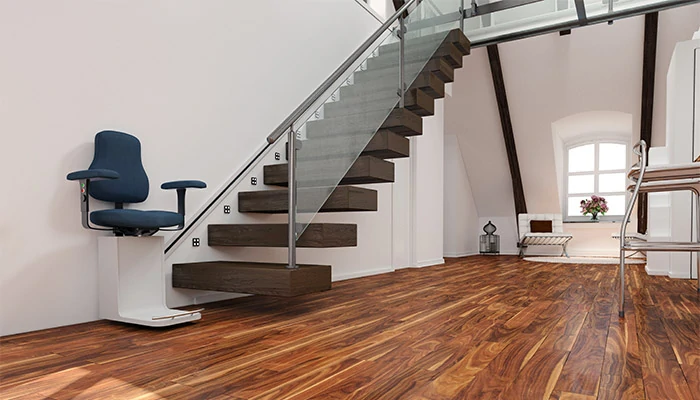
Stairlift are also a type of shaftless lifting equipment. Some people consider stairs to be its shaft, but they do not require civil engineering and do not completely occupy stair space.
A stair lift involves fixing a guide rail to an existing staircase, then fixing an electric chair to the guide rail, and using a motor to drive the chair to move back and forth along the stair railing.
Pros
First, stairlift does not require shafts, machine rooms, or pits—requiring minimal civil engineering work, less preparation before installation, and lower costs.
Secondly, the price of a stairlift chair is lower than that of a through-building home elevator without a shaft.
Third, it can help people with some mobility to go up and down stairs, thus saving energy and avoiding physical harm.
Fourth, it saves space to the extreme, requiring only a portion of the space along the edge of the staircase.
Fifth, it is flexible to assemble and disassemble. Because the stair lift itself is small and has a simple structure, it is easier to assemble and disassemble.
Sixth, the installation cycle is fast. For straight staircases, installation can be completed in less than a day.
Cons
The stair lift consists of an electric seat as its core component and can only carry one person at a time. Furthermore, it has weight restrictions for this individual, with the internationally accepted weight range being 127kg-136kg. In addition, stairlifts are usually installed one floor at a time; their convenience is greatly reduced if there are three or more floors. It is not suitable for people who need a wheelchair and cannot use it independently. If the staircase is narrow, installing a stairlift will affect its functionality.
Not all staircases are standard; curved staircases require custom-made guide rails, which are more expensive. For some major brands, the price of stairlift chairs is higher than that of through-wall home elevators without shafts.
Applicable Scenarios
Two-story residential buildings must have stairs, which can be installed in both new and old buildings. In addition, family members must have some level of mobility to use it independently.
Unenclosed Vertical Wheelchair Lift
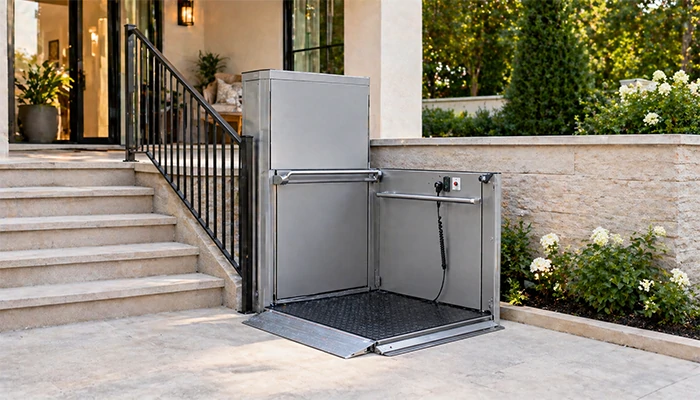
An open-type vertical wheelchair lift, also known as a vertical wheelchair lift, is an unenclosed type of accessible lifting equipment primarily used in low-rise residential buildings. Vertical wheelchair lifts require no dedicated shaft or civil engineering; they are guided by guide rails or columns. Currently, all vertical wheelchair lifts on the market are hydraulic or screw-driven, and can be installed both indoors and outdoors.
Pros
First, vertical wheelchair lifts offer excellent value for money, functioning similarly to home elevators but at a slightly lower price.
Secondly, it is specifically designed for wheelchairs, conforms to wheelchair dimensions, and allows for direct entry and exit without the need for transfers.
Third, it is easy to operate by starting with a button, making it suitable for the elderly.
Fourth, it occupies a small area, is flexible in installation, has low civil engineering costs, and does not require drilling holes between floor slabs.
Fifth, vertical wheelchair lifts typically have a load capacity of 250-350kg, which can help move heavy objects up and down stairs.
Sixth, it has fewer parts, a simpler structure, and lower maintenance costs.
Cons
Vertical wheelchair lifts are not enclosed spaces and are not suitable for people with a fear of heights. Furthermore, compared to home elevators, their lifting height is relatively low, typically around 3 meters, making them suitable for single-story use. In addition, vertical wheelchair lifts are not aesthetically pleasing, as most are gray-white, which clashes with the decorating style of villas and duplexes.
Applicable Scenarios
This device is suitable for single-story or one-and-a-half-story houses and homes with wheelchair users. And if it’s an older house without a wide staircase, and on a lower budget.
Incline Platform Lift
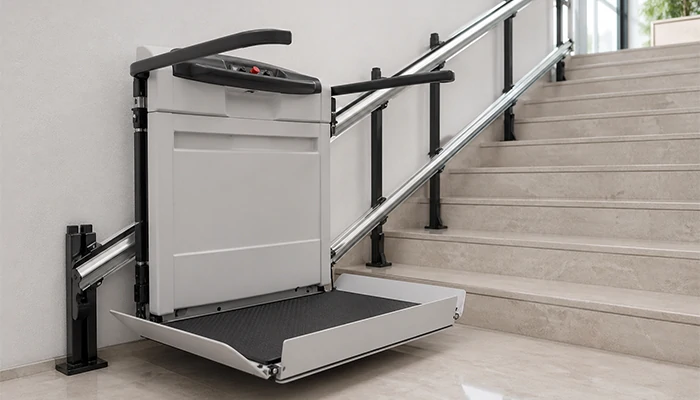
Inclined platform lifts are a combination of vertical lifting platforms and stair lifts. Compared to the three types of shaftless lifting equipment mentioned above, it is not well known to the general public.
Inclined platform lifts also install guide rails on the railings on one side of the stairs, and the main body (non-enclosed platform) is driven by a motor to move up and down along the direction of the stairs. The tilting platform lift looks like a “flying carpet”, and the surrounding barriers can be folded up so as not to affect the use of the stairs.
Pros
First, this device can help wheelchair users go up and down stairs.
Secondly, the platform is foldable, taking up almost no space and not affecting the use of stairs in the home.
Third, it is inexpensive, lower than shaftless home elevators and vertical platform lifts.
Fourth, installation is simple, taking only 1-2 days to complete, and requires minimal construction work that will not damage any part of the house’s structure.
Fifth, the device can operate at stair corners and is suitable for use on multiple floors.
Sixth, it is compatible with all staircases and has a load capacity greater than that of stair lift chairs.
Cons
The device operates at an angle, resulting in a less comfortable user experience compared to vertical lifting devices. And although it can be folded, it doesn’t mean it’s completely invisible; its function will still be affected if the staircase is very narrow. Furthermore, it is not a suitable choice if you are pursuing a beautiful home life. On the one hand, it is not aesthetically pleasing and has few customization options; on the other hand, installing it on a staircase may look out of place and affect the overall style of the house.
Applicable Scenarios
It is used in two-story houses with stairs. Users must be accompanied by someone when using it.
How to Choose Your Shaftless Lift for Home?
Assess Your Space
First, assess the space you can utilize. If you can reserve a minimum of 1m*1m space, allowing for floor slab cutting, and the floor slab’s load-bearing capacity meets the requirements of a home elevator. Congratulations! You can now install a Shaftless, Through-the-Floor Home Elevator.
Identify Your Needs
Carefully consider whether you are purchasing shaftless lifting equipment for short-term or long-term use. If you are looking for a long-term home-based elderly care system, then a home elevator is the best choice. Because it has a longer lifespan and is more convenient and safer. If it is for use in the short-term rehabilitation training phase, then stair lifts or tilt lifts are good choices. If it is intended for short-distance use—specifically to facilitate bridging the height difference between a building and the ground—opt for a vertical lifting platform.
Set Your Budget
Planning your budget in advance can reduce your workload. The price of home elevators tends to be relatively high; while prices for foreign-made units range from $10,000 to $60,000, home elevators imported from China are priced between $4,000 and $10,000. Stairlifts are relatively affordable, typically ranging in price from $2,000 to $8,000; however, for staircases with complex structures that require custom-made rails, the cost may be around $10,000. The price of a vertical platform lift ranges from $12,000 to $40,000, while the price of an inclined platform lift ranges from $6,400 to $28,000.
Safety
Among the four types of equipment mentioned above, the home elevator offers the highest level of safety; it is equipped with a variety of safety devices that safeguard the user’s safety from every angle. The second safest device is the vertical platform lift, which ascends vertically and poses no risk of tilting or tipping over. Furthermore, the device is equipped with full-height guardrails on all sides, an emergency stop mechanism that activates upon encountering an obstruction at the base, and an automatic descent function in the event of a power failure. The third safest device is the stairlift, which features a simple structure and a low failure rate. Finally, there is the inclined platform lift; lacking an enclosed cabin and operating on an incline, it poses risks such as tipping over.
Conclusion
The four types of shaftless lifting devices mentioned above can all help you create an accessible home with greater ease. However, if you are looking for a modern, stylish, and space-saving solution that offers long-term value and durability—one that can elevate the convenience of your daily life to a new level while enhancing your independence—then I recommend choosing a shaftless home elevator.
Where Can I Buy A Shaftless Home Elevator?
If you are interested in shaftless home elevators and are looking to select one for yourself or your family, it is crucial to choose a capable and trustworthy home elevator company. Here, I suggest you take a look at Anter—a specialized manufacturer that has been firmly established in the home elevator sector for 16 years. Their product range spans every category from small residential units to luxury villas, offering comprehensive customization—covering aesthetics, functionality, and accessories—and adhering to the philosophy: “Your needs; they make them happen.”
Located in Jining—known as China’s “Home of Elevators”—Anter operates an independent 10,000-square-meter facility comprising three production workshops and a design and R&D office, enabling us to provide you with a comprehensive, one-stop service encompassing planning, design, manufacturing, logistics, and after-sales support.
Additionally, Anter features an elevator showroom housing over 20 installed home elevators.
Please fill out the form on the right, and our specialists will immediately arrange your online or in-person factory inspection and elevator experience tour.
Faq
Are shaftless home elevators worth it?
Yes, among the four types of shaftless home lifting devices, the shaftless home elevator is the most worthwhile choice. Because it offers high security and great convenience, while also possessing aesthetic appeal and appreciation potential. Compared to other devices, its versatility allows it to meet your diverse needs.
The Shaftless Home Elevator VS Traditional Home Elevator
| Traditional home elevators (require shaft) | Shaftless Home Elevator | |
| Installation Requirements | An elevator shaft is required. | Can be installed without a hoistway. |
| Civil Engineering Requirements | Height, a pit and overhead clearance must be reserved. | Low profile, requires no pit, or only a shallow pit. |
| Space occupied | Relatively large | Relatively small |
| Suitable Housing Types | Houses with pre-allocated elevator shaft space | No space for a hoistway; older buildings. |
| Installation Cycle | Including the construction of the hoistway, it will take approximately one month. | Approximately one week, depending on the type of home elevator. |
What is shaftless home elevator cost?
The prevailing market price for shaftless home elevators ranges from $40,000 to $75,000, with the lowest prices hovering around $20,000. However, the actual price is determined based on factors such as the number of floors, elevator dimensions, elevator type, and selected configurations.
If you are looking for a relatively affordable home elevator, we recommend importing one from Ante; a two-story hydraulic “backpack” unit costs just $3,500. It offers excellent value for money and has been proven by customers—it can transform your life.
Can a shaftless home elevator 3 floors be installed?
Yes, hydraulic home elevators without a hoistway can be installed in 2- to 4-story buildings, while traction home elevators without a hoistway can be installed in 2- to 7-story buildings. If installing three layers, it falls within the standard range and can be installed.
Are shaftless lifts suitable for elderly people?
All four of the aforementioned devices are suitable for use by the elderly; furthermore—with the exception of the stairlift—the other devices can also be used in conjunction with a wheelchair. Moreover, shaftless lifting equipment is specifically designed for elderly individuals with mobility impairments; it serves as the ultimate mobility aid for seniors, capable of significantly enhancing their independence and convenience within their homes.
 English
  Arabic
  Vietnamese
  German
  Malay
Malay  Thai
Thai