
Introduction
With the increasing aging of the population, more and more families are realizing the need to renovate their homes to make them more suitable for the elderly or those with mobility impairments. Traditional accessibility modifications can address accessibility issues in single-story homes, but they have significant drawbacks for multi-story residences. Therefore, home elevators have become the most convenient, safest, and cost-effective long-term accessibility solution for multi-story homes. This article will provide a comprehensive description of home accessibility modifications, focusing on both single-story homes and multi-story homes with home elevators, offering you the perfect home accessibility solution.
Why Wheelchair Accessibility Is Important
Accessible facilities are not a luxury, but rather a guarantee of safe living and quality of life, and a fundamental condition for long-term independent living.
Safety is paramount, and it’s crucial to avoid the dangers encountered during transfers, reducing the risk of falls, trips, and slips that wheelchair users may experience when going up and down stairs, turning corners, and entering and exiting bathrooms and toilets. The cost of a single fall far outweighs the cost of accessibility modifications.
The ability to live independently, to move freely within one’s home, to go up and down stairs, and to use the bathroom independently – true independent living for people with disabilities is impossible without accessible facilities.
Accessibility modifications are not just for wheelchair users; they benefit the whole family, including pregnant women, children, obese individuals, those with temporary mobility issues, and those requiring long-term care at home.
Making homes wheelchair-accessible is a future trend and a worthwhile investment for the future.
The Best Ways to Make Your Home Wheelchair Accessible
For wheelchair users, ensuring accessibility within the home involves various modifications for single-story homes, including ramps, accessible bathrooms, etc. For multi-story homes, a home elevator combined with other accessibility modifications is the best solution.
How to Make Your Home Wheelchair Accessible
Accessible home renovations are not simply about installing a ramp or widening doorways; they are about providing wheelchair users with an environment where every movement is smooth, safe, and stress-free. This requires considering the overall movement routes, dimensions, safety features, and potential future changes in mobility. It involves creating seamless connections between all areas of the home, selecting appropriate ramps, handrails, lifting platforms, or home elevators based on individual needs, to create a truly comfortable, practical, and safe accessible home environment for long-term use.
Widening Doorways and Hallways
When wheelchair users move in and out of their homes and through hallways, the size of their wheelchairs can restrict their movement, making it difficult to navigate narrow spaces. Therefore, widening doorways and hallways is a very effective way to reduce bumps and jolts, allowing for easier access to their destinations. When choosing to widen them, understanding the dimensions beforehand is paramount. Currently, standard wheelchairs are approximately 24-26 inches wide, while wider wheelchairs are typically 30-32 inches. Therefore, a widened doorway or hallway of 38 inches is appropriate.
Installing Ramps
Ramps with gliding features can help wheelchair users move freely up and down residential areas with a few stairs. Ramps can connect indoor and outdoor spaces, bedrooms and living rooms, allowing free access to lower floors of the home. Additionally, we recommend using portable or foldable ramps, which are lightweight, easy to carry, and convenient for repeated use anytime, anywhere.
Installing Home Elevator
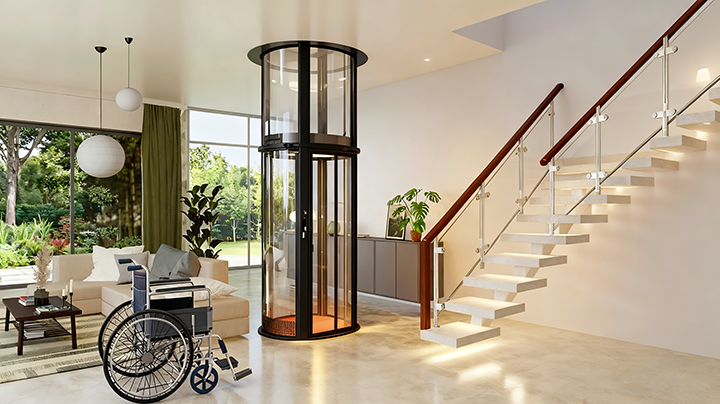
You can install a home elevator in your residence. Home elevators are ideal for multi-story homes and are the best assistive tool for people who need to use wheelchairs. Installing a home elevator expands the mobility of wheelchair users, allowing them to move between floors independently without assistance. It can also help wheelchair users carry items, improving their independence and reducing the worries of their families. In addition, home elevators have an elegant appearance, combining practicality and aesthetics, making them a wise and worthwhile investment.
We have written several articles about home elevators, covering all aspects of their design and maintenance; you can find them on our blog.
Modifying Bathrooms for Accessibility
As a key activity area in the home, the bathroom requires some modifications before it can be made accessible to wheelchair users. First, the shower area: use a threshold-free design for easy access, lay non-slip flooring, and add an adjustable showerhead. Second, the washbasin: a tiered design is recommended to accommodate user height. Install handrails throughout the bathroom for easy movement. Additionally, you can place a safety frame and a bench in the bathroom to reduce physical exertion.
Adjusting the Kitchen for Wheelchair Access
Kitchen layout is just as important as bathroom layout. You can choose to install a low-top countertop in the kitchen and include low-level storage for kitchenware, making it easily accessible. In addition, choose ADA-compliant appliances. ADA appliances meet the triple criteria of accessibility, ease of use, and high safety, and are designed and developed specifically for wheelchair users, making them the most beneficial choice for them.
Adding Safety Function
Add multiple safety features to your home. Worthwhile safety features to add to a residence include: handrails, non-slip flooring, motion-sensor lighting systems, one-button alarms, and safety racks. If you choose a home elevator, it already has multiple safety features and can also protect wheelchair users in their daily lives. Adding safety features to your home is crucial; it not only protects wheelchair users but also the daily safety of other family members, making it the best way to enhance home accessibility.
Technology and Smart Home Solutions
The concept of smart living is making home appliances increasingly intelligent, reducing difficulties for wheelchair users and allowing them to enjoy a barrier-free lifestyle. When decorating or renovating your home, you can choose smart furniture suites, including voice-controlled TVs, refrigerators, automatic doors, call alarms, smart home elevators, and fully intelligent lighting systems. You can use the facilities you want simply by voice or touch the screen to create the most suitable and comfortable space.
Cost and Budgeting for Accessibility Renovations
The specific cost of the renovation depends primarily on the chosen solution. This article categorizes the available accessibility measures into three types, and provides an estimated cost for each type.
Basic type: Includes installation of ramps and handrails. The price is relatively low, with ramps costing around $2000 and handrails around $100. Simple modifications to a bathroom, such as adding handrails, cost approximately $5000.
Medium-sized projects: Installation of a home elevator. The price ranges from $4,000 to $45,000, depending on the configuration, type of elevator, and number of floors. Renovation of kitchen and bathroom with lower countertops. The price is approximately $15,000.
High-end type: Complete smart home renovation, including automatic doors, lighting systems, etc., priced at $50,000 and above.
You can choose according to your budget.
In some countries, there are subsidies available for accessibility modifications, such as the Home and Community-Based Services (HCBS) program in the United States, and similar accessibility programs exist in Europe and Canada. Additionally, some insurance companies may provide funding, and you can also inquire with local charitable organizations, which may offer financial support. We recommend checking local websites for information on relevant benefit programs.
Conclusion
According to research, a person spends most of their life at home. Home is the warmest and most comfortable place. For people with disabilities, making their homes more compatible with their lifestyle is crucial. We recommend developing an accessibility plan and installing accessible equipment to make convenient living within your reach.
Anter, as a professional import and export company specializing in home elevators, can help you create the perfect accessible space. Our professional team provides one-stop service, from product selection and proper use to maintenance and repair. Simply fill out the form on the right, and a professional will contact you shortly to guide you into a new chapter of convenient living.
FAQ
Does Medicare pay for wheelchairs at home?
Medical insurance can cover part of the cost of home-use wheelchairs for medical purposes, but a doctor’s prescription and eligibility requirements are necessary.
Can a home elevator fit in a small house?
It is possible to install a home elevator in a small apartment or house; there are customized solutions for home elevators designed for small spaces.
Can a home elevator carry a wheelchair with the user inside?
Home elevators are capable of carrying wheelchairs and their users. The typical load capacity of a home elevator is between 250 and 450 kilograms.
How much space do I need for a wheelchair to turn around inside a house?
A standard wheelchair is 60-70 cm wide, and a turning radius of 1.5 meters allows the wheelchair to rotate 360 degrees in place.
Is a home elevator better than a stair lift for a wheelchair user?
For wheelchair users, a home elevator is better than a stairlift, as a stairlift still requires assistance to transfer the user onto the seat.
 English
  Arabic
  Vietnamese
  German
  Malay
Malay  Thai
Thai