
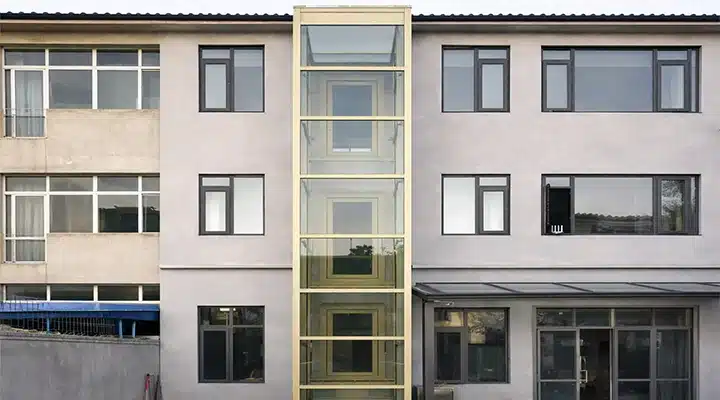
An increasing number of people wish to install a home elevator in their residence; however, not all homeowners have allocated sufficient space for one at the outset of their renovation projects. To address this challenge, outdoor elevators have emerged as a flexible and viable solution.
Compared to indoor home elevators, outdoor elevators not only avoid occupying interior space but also offer aerial panoramic views. Furthermore, outdoor elevators are perfectly suited for multi-story residences; they facilitate the transport of heavy items, ensure safe travel, and allow for rapid movement between floors—making them particularly ideal for families with members who have mobility challenges.
However, before purchasing and installing an outdoor elevator, it is crucial to understand the associated costs and the factors that influence them——this can help you plan a reasonable budget and reduce your expenses. This article provides a detailed introduction to outdoor elevators and addresses your most pressing questions; we hope you find it helpful.
What is Outdoor Lift?
An outdoor elevator is a fixed lifting device installed and operated outdoors. It typically possesses strong environmental adaptability, offering resistance to water, rain, sunlight, corrosion, and more. Compared to indoor elevators, the materials used are of higher strength, and the internal components require special protective treatment.
Outdoor elevators are generally divided into two types. One type is a vertical lifting platform with a semi-enclosed cabin, featuring a simple structure. Another type features a fully enclosed cabin—an elevator system similar in operation to commercial elevators—with a relatively complex structure.
Outdoor elevators are typically installed in the following locations:
The side or front-facing side of a residential exterior wall
At the corner of the house
Within the courtyard, connected by a platform.
Beside the garage
At the balcony or terrace
Areas with a difference in elevation (sloping terrain)
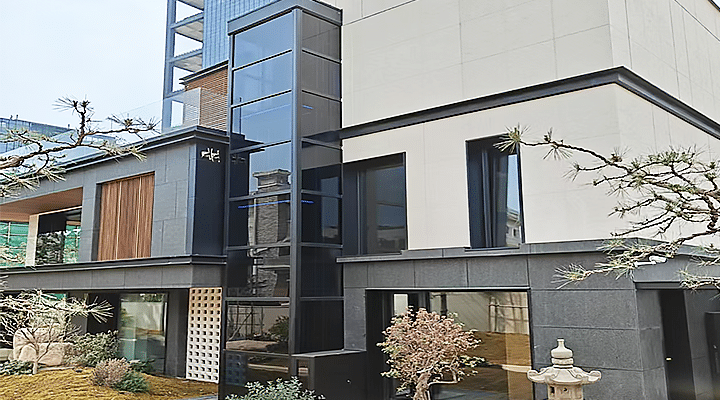
The Factors Affecting Cost
Outdoor elevators are custom-made products, and their prices are not fixed. Therefore, if you wish to gain a clearer understanding of outdoor elevators, you must first identify the various factors that influence their price. The following is a detailed list:
Number of Floors
When estimating the cost of an outdoor residential elevator, the number of floors is a crucial influencing factor. For each additional floor, a corresponding set of landing doors and various safety devices must be installed, and the lengths of the guide rails and cables must be extended. Based on average data, the price of an elevator increases by $5,000 to $15,000 for each additional floor.
Elevator Type
Due to their simple structure and modest aesthetic appeal, vertical platform lifts typically cost less than outdoor elevators. Reflecting the diversification of the home elevator market, outdoor elevators can be further categorized into four types: traction elevators, hydraulic elevators, screw-driven elevators, and vacuum elevators. For details regarding elevator types, please continue reading the article : types of home elevators.
Among these four types, screw-driven and vacuum elevators are the most expensive due to their high technical barriers and low production volumes. Traction elevators have a relatively complex structure and are currently the mainstream type on the market; therefore, price is secondary. Hydraulic elevators, owing to their simple structure and highly mature technology—which has led to the establishment of standardized processes—are therefore the most affordable option.
Elevator Structure
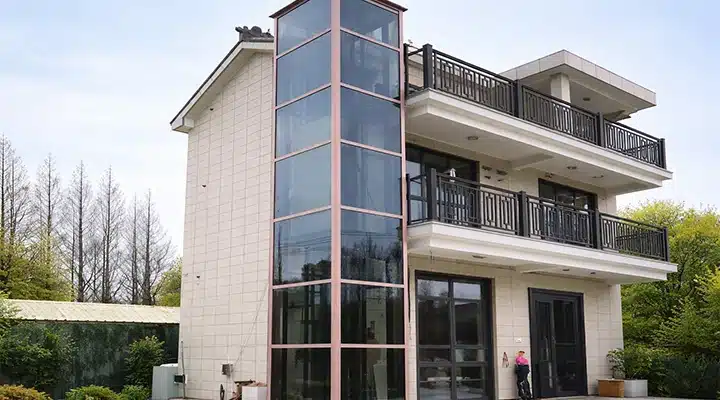
The shaft structure for outdoor elevators comprises three types: Fully Enclosed Steel Structure Hoistway,Semi-Enclosed / Unenclosed Hoistway,Panoramic Glass Shaft. Among these, the panoramic glass requires high-quality materials and involves a complex processing workflow, making it the most expensive option. Fully enclosed hoistways require a greater quantity of materials; consequently, they are more expensive than semi-enclosed or open hoistways.
Customization Options
The price will vary depending on the specific configuration selected for the outdoor elevator. Residential outdoor elevators combine both aesthetic appeal and practicality, offering a high degree of flexibility. Various options will be provided, including materials, shapes, dimensions, load capacity, lighting, engraved patterns, and additional features. These personalized configurations allow your elevator to seamlessly integrate with your home, enhancing its sense of luxury.
Foundation Construction
The foundation accounts for a significant portion of the construction costs for outdoor elevators. The price varies depending on the condition of the foundation. For typical hard-soil foundations, construction costs are minimized; concrete pile caps can be constructed directly, with components pre-embedded in advance. For relatively loose soil, it is necessary to replace the soil and thicken the foundation. As for sloped terrain—locations characterized by differences in elevation—procedures such as excavation, leveling, and reinforcement are required. If the ground consists of rock, drilling and blasting will be required, resulting in higher construction costs.
Waterproofing and Anti-corrosion Treatment
Compared to indoor elevators, the mechanical structures of outdoor elevators are frequently exposed to the external environment. To prevent rapid deterioration, the circuitry and components must undergo waterproofing and anti-corrosion treatments to safeguard against damage caused by changing weather conditions.
Installation Difficulty
The installation cost for outdoor elevators is typically calculated based on the installation time. The more complex the elevator structure and the greater the volume of materials involved, the more challenging the installation becomes; consequently, the installation process requires a longer duration. Furthermore, the installation of complex elevators demands a higher level of technical expertise from the workforce, leading to a corresponding increase in daily labor costs.
Local Regulations and Approvals
In some jurisdictions, the installation of elevator equipment requires compliance with relevant regulations and the obtaining of permits. However, if the outdoor elevator is intended for residential use, the approval costs in most regions are close to zero. However, some jurisdictions require that construction obtain planning permission and building approval, which may incur fees ranging from $400 to $1,500.
Manufacturer
Manufacturers price identical products differently. Renowned manufacturers, in particular, incorporate a fee for their brand—known as a “brand premium”—when pricing their elevators. Most brands typically mark up the base price by 15% to 30%.
The Average Cost of Outdoor Lift
The following is the price range for outdoor elevators in 2026. However, prices are constantly changing, so please refer to them with caution.please use this information for reference with caution.
| Type | Cost (Device+Installation Cost) |
| Vertical lift platform | $4000- $12000 |
| Hydraulic Elevator | $15000- $60000 |
| Traction Elevator | $30000- $70000 |
| Vacuum Elevator | $30000- $70000+ |
| Screw Elevator | $50000- $100000 |
Is An Outdoor Lift Worth the Cost?
Installing an outdoor elevator on the exterior of an existing building is more cost-effective than installing an indoor one, as it requires neither the removal of floor slabs nor the reinforcement of the floor structure; it is, therefore, a highly worthwhile investment. An outdoor elevator does not occupy any indoor space, requires no alteration to internal circulation paths, and causes no damage to the interior structure; it is therefore ideally suited for installation in older homes. Furthermore, outdoor elevators can be customized to suit the specific outdoor structure, offering a very high degree of flexibility.
Furthermore, outdoor elevators offer a high level of convenience, saving both physical effort and time when moving between floors. From a long-term perspective, it also serves as an excellent aid for aging in place, enabling seniors with limited mobility to navigate more easily, minimize the risk of falls, and engage in a wider range of outdoor social activities.
Installing an outdoor elevator is not merely a simple expenditure; the equipment itself possesses inherent value-adding attributes that can appreciate the property’s worth, enhance its luxury appeal, and help the owner attract a wider pool of prospective buyers.
Cost-Saving Tips for Your Outdoor Lift Project
Select Standard Size
Provided that installation and usage are not compromised, opting for the standard dimensions offered by the elevator manufacturer will minimize your costs as much as possible. Typically, the price for custom-sized outdoor elevators increases by 15% to 30%. Furthermore, if you are not seeking a luxury elevator, a standard configuration will suffice to meet your vertical transportation needs.
Compare Prices from Different Suppliers
The price of home outdoor elevators varies in different regions, and many brands may charge a premium, resulting in situations where the price does not match the product.
Therefore, before purchasing, you need to contact multiple manufacturers and obtain quotes, and make a decision only after repeatedly comparing quality and price.
Ensure Welfare Subsidies
In some areas, you can apply for subsidies when purchasing elevator equipment to renovate a residence. You can check the local policies and regulations for details.
Install Elevators During Renovation
If you happen to be renovating your home, now is the best time to install an elevator. Because labor costs, construction costs, and the cost of obtaining construction permits can be shared equally.
Choose The One with Its Own Support Equipment
If your residence does not have a shaft, it is recommended that you use equipment with its own frame support. The price of the equipment will be far lower than the labor and material costs of modifying the wellbore.
Conclusion
There is no specific standard for the price of an outdoor elevator; it is affected by your specific circumstances and needs. However, the price range provided in this article can help you create a preliminary budget plan and effectively control costs before you officially purchase an elevator, allowing you to make the wisest decision faster. Let outdoor elevators change your life and make every day more convenient!
Why Choose Anter Home Elevators for Your Outdoor Elevator?
Anter combines unparalleled design with precision manufacturing technology, and always aims for innovation, practicality, and uniqueness in its research and development.
Anter currently has a 10,000-square-meter factory, where sheet metal is produced and installed in-house, allowing for customization of frame materials, colors, and shapes. At the same time, we also has three production lines with an average annual elevator production of 2,000+, which can meet your project needs.
Anter supports ODM/OEM services, providing comprehensive elevator customization services and can build your own exclusive outdoor elevator.
Anter provides a one-stop service from design to installation, so choose us and you just need to wait for us to bring it to you.
Finally, Anter has always been committed to providing the best product quality and the most professional and sincere service. Choose Anter, and enjoy a luxurious visual experience and the most convenient ride, while ensuring your safety and increasing the value of your home! Contact Ant today to install your outdoor elevator!
FAQ
How much outdoor and indoor home lift Cost?
| Type | Total Cost Range (Equipment + Installation) |
| Outdoor Lift | $20,000 – $60,000 |
| Indoor Lift | $30,000 – $70,000+ |
What is the most economical type of outdoor elevator?
The most economical type of outdoor elevator needs to be determined based on your specific circumstances, because only the elevator that is most suitable for you will allow you to use it for a longer period of time and have a better experience. However, hydraulic elevators are generally recognized as the lower-priced type on the market.
Can I install an outdoor elevator in a coastal area?
Yes, we specifically designed a beach house elevator for coastal areas. We use high-strength steel and high-performance core components, and apply waterproof, corrosion-resistant, rust-proof, and impact-resistant processes to ensure long-term stable use even in humid regions.
Do outdoor elevators need a pit?
Traditional outdoor elevators typically require a pit. However, there are also outdoor elevators that do not require a pit or only require a shallow pit.
What is the annual maintenance cost for an outdoor elevator?
Outdoor elevators typically require maintenance once a year or every six months, and this service must be provided by a professional elevator maintenance company. The cost of a single maintenance service is around $150 to $300. If you sign a contract with a maintenance company, the annual maintenance cost will be approximately $500.
How long does it take to install an outdoor elevator?
The on-site construction and installation of the outdoor elevator will take approximately 1-3 weeks. The on-site construction time is relatively long, which may take up to 2 weeks, while the actual installation may only take 3-7 days.
 English
  Arabic
  Vietnamese
  German
  Malay
Malay  Thai
Thai