
Home elevators are not only a means of transportation that improves the convenience of living in a residence, but they are also gradually becoming an investment choice for more and more families to showcase their taste and increase the value of their homes. Whether you’re planning to install an elevator in a new house or upgrading an existing home elevator, understanding the types and brands of home elevators and the factors to consider is crucial.
This guide provides a systematic overview of the most mainstream home elevator types currently on the market and analyzes the most popular top home elevator brands globally as of 2026. Hopefully, this will inspire you to find the most suitable solution.
Home Elevator Types Explained
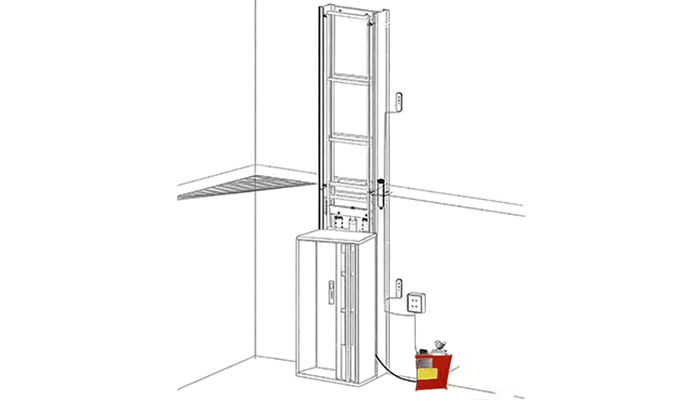
Hydraulic Elevator
Although hydraulic elevators are no longer a mainstream product segment in the global home elevator market, they still hold an indispensable position. It accounts for 13%-20% of the total market share. Hydraulic elevators are cheaper than other types of elevators, therefore, they hold a dominant position in the lower-end market. Many low-budget families still choose this category when installing or replacing home elevators.
A hydraulic elevator is constructed by a pump that pressurizes hydraulic oil into a cylinder, which in turn pushes a plunger to move linearly, thus lifting the car and causing the elevator to move upwards in a linear motion. When the hydraulic oil flows back to the oil tank, the plunger retracts, and the car begins to descend slowly, thus achieving the downward linear motion of the elevator.
Hydraulic elevators have a high load capacity and low requirements for the shaft, but their lifting height is limited. They are suitable for low-rise residential buildings (villas, duplexes, self-built houses) and older buildings.
Traction Elevator
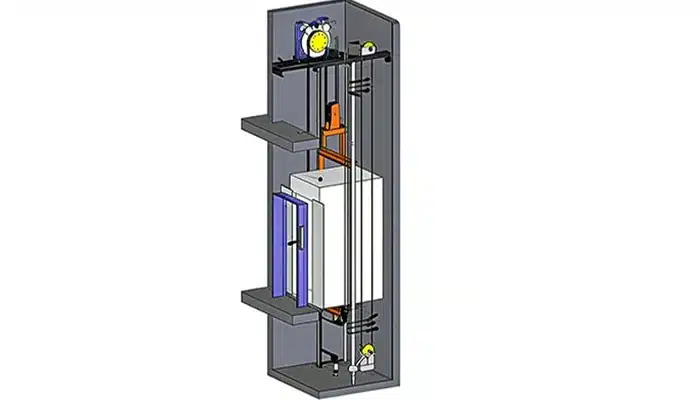
Traction elevators have been used in residential applications for over 100 years. Traction technology also became very mature during this period and can be called an industry benchmark. Traction elevators are also a very safe type of elevator, with a fall accident rate close to 0. Currently, traction elevators dominate the residential market, accounting for 78%-85% of the market share. Furthermore, looking at future trends, the dominant position of traction elevators in the global home elevator market will not change.
Traction elevators rely on a motor to drive the traction sheave, which generates static friction between the wire rope and the groove of the traction sheave, thus pulling the car and counterweight suspended at both ends of the wire rope to move upward and downward. Traction elevators are energy-efficient, fast, and have a longer lifting height. They are typically used in mid- to high-rise residential buildings, as well as large and high-end residences.
Vacuum Elevator
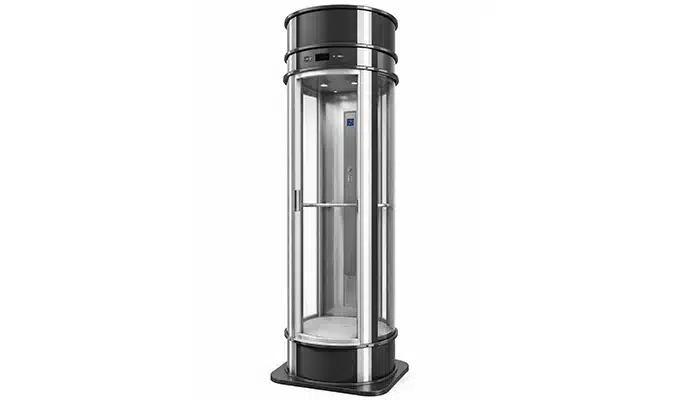
Vacuum elevators are an innovative sub-category of home elevators. The first home product was launched in 2002, and it was not until 2004 that it was installed in homes. Compared to traction elevators and hydraulic elevators, vacuum elevators are a very niche category of elevators in the global home elevator market, with a low market share and few people typically choose them.
Vacuum elevators are also known as pneumatic elevators. When the vacuum elevator ascends, the vacuum pump at the top is turned on to draw in the air above, thereby creating a pressure difference inside the closed shaft, causing the car to move upward. When the vacuum elevator descends, the top exhaust valve is activated, releasing a small amount of air, reducing the pressure difference between the top and bottom, and causing the car to move slowly downwards according to its own weight. Vacuum elevators are a niche, high-end type of elevator, suitable for 2-5 story residential buildings, including villas, duplexes, and retirement homes.
Screw Elevator
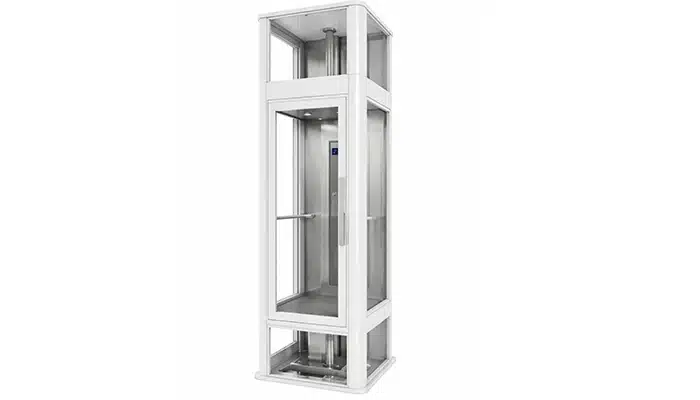
Screw elevators have a long history, having been invented in the 18th century and officially applied to residential use at the end of the 20th century. Screw elevators are the “safety benchmark” and “space king” of home low-rise elevators. They are a revolutionary solution that improves the barrier-free solution for installing elevators in small and old houses. In the global home elevator market, screw elevators account for 35-45% of the market share.
A screw elevator uses gears or belts to drive a nut to rotate upwards along a screw, thereby lifting the car upwards. When the car reaches the top, the gears or belts rotate in the opposite direction, causing the nut to rotate downwards, and the car slowly descends. The screw elevator’s threaded engagement mechanism makes the device very safe. However, this technology is only in the hands of a few companies, and it is complex and expensive. Screw elevators are suitable for installation in self-built houses, villas, high-end apartments, duplexes, and other buildings.
Best Home Elevator Brands in 2026
Otis Elevator Company
Otis was a key company that made elevators popular, and it is the pioneer and benchmark in the industry. Otis’s invention of the elevator safety braking device led to the rapid development of modern elevators.
Otis is an important player in the home elevator sector, but it is not a dedicated manufacturer. Otis focuses on the high-end market, leveraging its advanced technology in commercial elevators to extend into the manufacturing of home elevators, pursuing high standards for dust and toxicity control. Otis boasts a comprehensive service system and its products are backed by top-tier brands. However, the price is relatively high, and since home elevators are not their core focus, customization flexibility is limited.

KONE
KONE is a leading global elevator manufacturer based in Finland, and one of the world’s four largest elevator manufacturers (alongside Otis, Schneider Electric, and TKE). KONE elevators are primarily driven by technology and design, and are highly functional elevators. KONE elevators are energy-efficient, environmentally friendly, quiet, comfortable, and highly intelligent.
In addition, in the home elevator sector, KONE positions itself in the mid-to-high-end market. Its elevators are aesthetically pleasing, highly functional, and backed by top brands. However, home elevators are not KONE’s core focus, so its elevator expertise may be lower than that of companies that specialize in home elevators, and KONE’s home elevators are expensive.

TK Elevator
TK Elevator is one of the world’s leading German elevator brands. Its innovative technologies and high-end projects are highly representative. TK Elevator’s MULTI elevator system uses magnetic levitation technology, allowing it to move vertically or horizontally, earning it the nickname “subway” for elevator platforms. In the area of home elevators, TK does not make it a core focus, but it has strong customization capabilities and provides elevators with a strong sense of design. Meanwhile, TK elevators are highly functional, run smoothly and quietly, and cater to high-end projects that prioritize design, hence their high price.

Mitsubishi Electric
Mitsubishi is one of Japan’s largest manufacturers of electrical and electronic equipment, and one of the most influential elevator manufacturers in the world. Mitsubishi Elevator, along with Otis, KONE, and TK, belongs to the same category; they are all top global elevator brands and have a significant influence in the Asian region.
Mitsubishi possesses sophisticated control technology that ensures the elevator remains exceptionally smooth and quiet during operation, offering an experience of unparalleled comfort. Mitsubishi stands as a representative brand for high-quality and stable home elevators, characterized by its safety, reliability, and long service life. However, Mitsubishi is not a manufacturer specializing exclusively in home elevators; consequently, it offers limited flexibility in terms of customization. Furthermore, its pricing is steep—comparable to that of Otis and Kone.

Inclinator Company of America
Inclinator is North America’s oldest brand dedicated to manufacturing home elevators. At the same time, it stands as the most representative brand in the home elevator sector, renowned for its mature product range and robust customization capabilities.
Inclinator possesses a professional elevator design team and engineering team. Each elevator is handcrafted using authentic American manufacturing techniques and undergoes rigorous inspection, ensuring exceptional durability and comprehensive customization capabilities. However, compared to Otis and Kone, it exerts less influence; furthermore, its operations are primarily focused on the U.S. market, and its level of internationalization is lower than that of the aforementioned brands. Furthermore, while its technology is relatively mature, it lacks innovation.
Savaria
Savaria is a leading Canadian brand of accessibility solutions and home elevators. It focuses on providing the most professional solutions for mobility in later life and boasts a highly comprehensive product line—from small elevators to panoramic lifts, we can meet the full range of residential needs.
Savaria positions itself within the mid-range market, placing a greater emphasis on practicality while possessing strong capabilities in customization. However—much like Inclinator—it primarily targets the North American market, making it highly regional in nature.

AmeriGlide
AmeriGlide is also a U.S.-based company specializing in residential accessibility elevators, distinguished by its high level of recognition and significant brand influence. Established in 2000, the brand boasts a diverse product portfolio that includes home elevators, stairlifts, platform lifts, and more. AmeriGlide is one of the brands in North America offering the most comprehensive range of home mobility solutions.
AmeriGlide is also the brand with the most transparent pricing. Compared to Kone, Otis, and TK, the pricing is lower, and it primarily serves the mid-range market. While AmeriGlide offers established solutions, its technology is not at the industry’s cutting edge, and its brand image leans toward economy and practicality.
Nationwide Lifts
Nationwide Lifts is one of the home elevator brands in the United States with the most extensive service network and the strongest after-sales support. It integrates products and services, selling elevator-related services alongside its products; it is a service-led company.
Furthermore, the brand’s product line is highly mature, covering the majority of current accessibility equipment for both home use and small-scale commercial applications.
Nationwide Lifts’ service network is mostly located in the United States, the brand is crucial for American users. However, in other countries, its influence is relatively weak and brand recognition is low; furthermore, the performance of the brand’s products is heavily dependent on the local installation teams.
Anter
Anter is located in Jining, China’s “Home of Elevators.” Since 2010, we have focused exclusively on the production of home elevators; our business operations span the entirety of China, and in 2017, we began expanding into overseas markets. Although Anter is not as renowned as the brands mentioned earlier, it has earned widespread recognition thanks to its stable performance, affordable pricing, and professional, timely service.
They offer a wide range of residential elevator solutions. Each product is crafted using high-quality domestic and imported materials and processed by professionals. Furthermore, every step of the entire process adheres to established production standards and undergoes multiple rounds of rigorous quality inspection. Consequently, the product offers a high level of safety and a long service life.
To facilitate a better understanding of the strengths of major brands of home elevator, the information is presented below in a table format.
| Brand | Stand Out for |
| Otis Elevator Company | The highest safety standard |
| KONE | Most comfortable to use |
| TK Elevator | The most technologically advanced and innovative |
| Mitsubishi Electric | Precision manufacturing and smooth operation |
| Inclinator Company of America | Strong home customization capabilities |
| Savaria | The most comprehensive product portfolio and the strongest integration. |
| AmeriGlide
| Most transparent pricing |
| Nationwide Lifts | Strong after-sales service |
| Anter | The Best Value for Money |
Other Factors Should Be Considered When Purchasing a Home Elevator
When purchasing a home elevator, in addition to understanding the various types and brands available, you should also familiarize yourself with the following key factors:
Floor height:Home elevators are typically suitable only for residences ranging from 2 to 7 stories in height.
Civil Work Status:It is necessary to determine whether the residential building possesses an elevator shaft and pit, as well as the load-bearing capacity of the floors, in order to formulate the preparatory construction plan for the elevator installation.
Load Capacity: The load capacity of a home elevator typically ranges from 250 kg to 400 kg, though the specific capacity is determined based on your individual needs.
Custom made: Residential elevator companies typically offer a variety of customization services. You should consider whether your choices are compatible with the style and construction of the house.
Accessibility Facilities: If a home elevator is being installed for use by household members with mobility impairments, one should consider whether the cabin features handrails, is spacious enough to accommodate a wheelchair, and is equipped with an emergency call function.
Maintenance and Care: Determine the maintenance schedule for the home elevator, as well as daily maintenance procedures. At the same time, gain a clear understanding of the duration and scope of the free elevator maintenance and servicing provided by the company, and estimate any additional costs that may be incurred.
Conclusion
Selecting a home elevator that aligns with your specific circumstances and needs is far more important than blindly choosing one from a major brand. Carefully researching and evaluating every elevator brand—and finding a trustworthy manufacturer—ensures that you will enjoy a comfortable and convenient riding experience for decades to come.
Install a home elevator! Add beauty to your home and a touch of novelty to your life.
Consider Installing An Anter Home Elevator in Your Home
If you are struggling to find a suitable manufacturer for a home elevator, why not consider Anter—the brand that offers the best value. Specializing in the manufacture of residential traction and hydraulic elevators, they possess 16 years of extensive experience, have successfully completed thousands of projects, and stand as a leading residential elevator brand in China.
Their elevator designs feature a high degree of flexibility, offering a variety of customization options to create a truly unique home elevator system tailored specifically for you.
They possess a 10,000-square-meter factory and a two-story, high-end showroom, enabling them to offer you the most competitive prices and the most intuitive elevator riding experience.
They also possess sophisticated production equipment, advanced manufacturing processes, and a team of experienced technicians and designers capable of recommending and planning the most suitable home elevator for you, tailored to your specific circumstances and budget.
Choose Anter for the highest quality products and the most sincere service. Visit their website and leave your contact details; you will receive a response within 8 hours, obtain a professional, complimentary consultation, and receive assistance in formulating the most suitable elevator solution for your needs.
FAQ
What Is A Home Elevator?
A home elevator is a compact, private lifting device. It is designed specifically for single-family homes, intended for the inter-floor transport of people and goods. Home elevators can be customized to suit specific homes and requirements; equipped with a wide range of safety features, they are products characterized by both high safety standards and a high degree of personalization.
Is a Home Elevator Right for Me?
Home elevators are suitable for all families living in multi-story residences. For households with members who have limited mobility, a home elevator serves as a convenient tool for accessible transit, helping to create a comfortable living environment. A home elevator serves as a hallmark of luxury living; installing one not only showcases your refined taste and status but also elevates the overall sense of sophistication within your home. When you own a home elevator, it serves as a safeguard for your future retirement; not only does it increase the value of your home, but it also ensures your safety.
What Is The Difference Between Hydraulic and Traction Home Elevators?
Hydraulic and traction elevators differ in terms of price, structure, drive mechanism, lifting height, load capacity, and other aspects. For an in-depth analysis of the differences in depth requirements between traction elevators and hydraulic elevators, please continue reading: Hydraulic Elevators vs. Traction Elevators.
Are Big Brands Always The Best Choice for Home Elevators?
No, big brands aren’t necessarily suitable for everyone. The big brands offer guarantees in terms of safety and brand reputation; however, they also have certain limitations and may fall short in areas such as customization, cost-effectiveness, and service responsiveness. While major brands are excellent, for most families, it is even more important to choose a manufacturer that fits their budget, meets their customization requirements, and provides professional, timely service.
How Much Does A Home Elevator Cost?
The price of a home elevator generally cannot be determined directly. This price is influenced by the number of floors where the elevator is installed, the type of elevator selected, and the specific configuration. If you would like to know the specific cost of installing a home elevator in your residence, please leave your contact details and specific requirements. A professional will calculate the estimate for you and send it to you shortly.
How Much Space Does an Anter Elevator Need?
We typically determine the size of a home elevator based on the number of people it needs to accommodate. We also offer elevators specifically designed for spaces with limited clearance, requiring an installation area of just 960 x 1250 mm.
 English
  Arabic
  Vietnamese
  German
  Malay
Malay  Thai
Thai