
Currently, many houses are equipped with underground garages—these are not only spaces for storing vehicles, but also important entrances and exits connecting the residential area. However, the steps between the garage and the interior act as a passage barrier, restricting the movement of people with mobility difficulties or disabilities. To address this challenge and help family members create a more convenient mobility environment, we need to find accessibility solutions and apply them in garages.
In reality, not all accessible devices are suitable for your space. Factors such as space size, lifting height, load-bearing capacity, waterproof performance, and installation conditions will narrow down your choices. Therefore, in order to make the most informed choice, we need to carefully compare each type of accessibility equipment.
Next, let’s look at some common accessibility devices to help you find the right solution.
Types of Garage Accessibility Lifts
Home Elevator
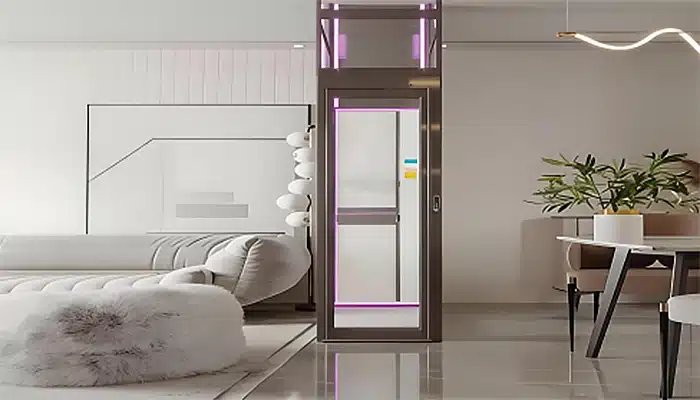
A home elevator is a small, barrier-free lifting device installed in a private residence for the exclusive use of family members.
Pros
If your residence has 2-7 floors, you might consider a home elevator solution that covers all floors at once.
Home elevators can ascend more than 20 meters, solving not only the problem of going up and down in the garage but also traveling between different floors inside the house. It offers dual convenience.
Home elevators enable truly barrier-free access. From the garage to the bedroom, there is no height difference, no ramp, no threshold, and no need to climb stairs. The elderly and disabled can use it independently without assistance.
The device is easy to operate; it can be started with a simple press. It is also equipped with an emergency button, which can immediately stop operation in case of emergencies—providing you with both safety and convenience.
Home elevators also have advantages that other accessibility devices do not have—aesthetics and added value. Home elevators are customized products that combine practicality and aesthetics. It is not a cold, mechanical device, but an artwork that can blend into the interior design and enhance the aesthetics of a home.
In addition, elevators are generally considered to be a standard feature in high-end residences. In the housing market, those seeking a high-end lifestyle are willing to pay the premium for properties with elevators. At the same time, residential buildings with elevators broaden the target customer base, attracting families planning to age in place and those with members who have mobility issues.
Home elevators also have the longest service life among common mechanical accessibility devices. Legitimate products have a designed lifespan of 15 to 20 years; however, with proper maintenance, their service life can be extended to 25 years.
Cons
As an accessibility feature for the home, residential elevators are not without their limitations.
First of all, not all residences can accommodate the installation. Installing a home elevator requires reserving space for the hoistway, a ground-level pit, and overhead clearance. For older residences and small-sized units lacking sufficient reserved space, renovation presents significant challenges and entails high costs.
Secondly, the average cost of a home elevator is slightly higher than that of other accessibility devices. Data for 2025–2026 indicates that the global average price of home elevators ranges between $10,000 and $60,000.
Third, the construction period for home elevators is long. Standard 2-to-4-story home elevators require one week for installation, whereas structurally complex home elevators or those intended for taller residences are estimated to require a 10-day installation period.
Finally, home elevators constitute a fixed structural installation and cannot be moved at will. However, if you are moving or reselling the equipment, you may contact a professional to disassemble and subsequently re-install it.
Applicable Scenarios
Domestic elevators are not suitable for use in public spaces; installation is recommended within the garages of detached villas, custom-built rural homes, townhouses, duplexes, or split-level residences.
Platform LIft
Platform lifts are classified into two types—vertical and inclined—characterized by the absence of a fully enclosed cabin; instead, a load-bearing platform, enclosed on all sides by guardrails 0.8 to 1 meter in height, travels along guide rails sheathed in aluminum plating.
Inclined Platform Lift
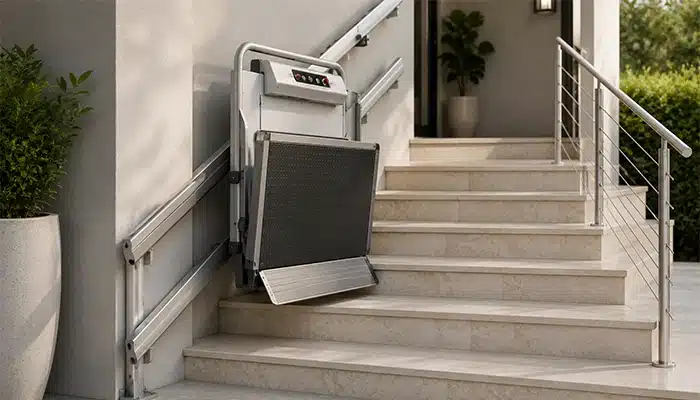
An inclined platform lift, also known as a stair-mounted inclined lifting platform, is installed on a staircase and travels up and down along the direction of the handrail. It is a combination of a vertical platform lift and a stairlift. Although inclined platform lifts are not commonly seen in everyday life, they are sometimes well-suited for installation in a garage.
Pros
Easy to install:The inclined platform lift is simple to install; it requires neither the removal of the staircase nor the construction of a hoistway.
Flexible installation:Inclined platform lifts can be installed on straight staircases, curved staircases, corner staircases, and similar settings; the guide rails can be customized.
Easy to maintain:This accessibility device features a simple structure with few components; it is durable, and its maintenance is relatively simple.
Small footprint:The inclined platform lift is installed flush against the side of the staircase, and its platform is foldable. When not in use, it will not interfere with the normal use of the stairs.
“Wheelchair Assistive Device”:The inclined platform lift is capable of transporting wheelchairs; it is equipped with guardrails on all sides to ensure the safety of the user.
Cons
Slow speed:The average speed range of an inclined platform lift is 0.05 m/s to 0.15 m/s, classifying it as a low-speed accessibility device. When the staircase connecting the garage to the interior is relatively long, it consumes a significant amount of time.
Lacking complete convenience: The platform travels along the trajectory of the staircase, with stopping points situated within the stair tread area; unlike an elevator, it cannot descend vertically to reach the interior floor level. Upon arrival, short-distance movement and assisted transfer are still required.
Not suitable for people with a fear of heights:Non-enclosed housing; a exposed feeling.
Customization costs are high:For non-standard stair configurations, the costs for equipment, installation, and maintenance increase significantly when custom guide rails are required.
Occupy Staircase Space:For very narrow staircases, installing this inclined platform lift would interfere with the use of the stairs.
Risk of Bumping: On some units, the tracks protrude, which may cause children and the elderly to sustain scrapes or bumps during use.
Applicable Scenarios
The only requirement for the application of an inclined platform lift is that the residence be equipped with a staircase that has a handrail installed on one side.
Vertical Wheelchair Platform Lift
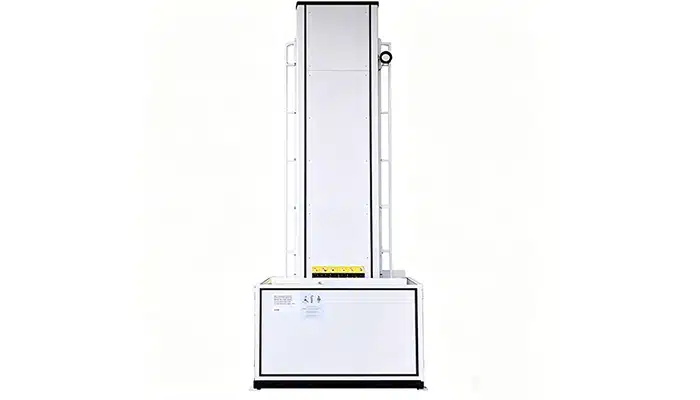
A vertical platform lift is often referred to as a simplified version of a home elevator; its guide rails are installed vertically, allowing the platform to travel straight up and down.
Pros
Small footprint: The minimum dimensions for the vertical platform lift can be customized to 750 × 1000 mm and 800 × 1000 mm.
High Convenience: A vertical platform lift is capable of ascending two to four stories; when installed in a garage, it can provide direct vertical access to a second-floor living room or bedroom.
Low installation costs: Compared to home elevators—which also allow for travel across multiple floors—vertical platform lifts feature a simpler structure and lower installation costs.
High Security: The vertical platform lift is equipped with safety features found in residential elevators, including anti-pinch protection, an emergency stop button, emergency lowering in the event of a power failure, safety door interlocks, and a non-slip platform.
Cons:
Slow speed: The average speed also falls between 0.05 m/s and 0.15 m/s.
Low comfort level:Vertical platform lifts generate noise, create noticeable drafts when used in a garage, and lack both privacy and a sense of luxury.
Low aesthetic appeal:Vertical platform lifts possess a strong mechanical aesthetic but lack visual elegance, making them incompatible with the style of a luxuriously appointed garage.
Danger:Some models of vertical platform lifts do not have a completely enclosed cabin, which may be dangerous for frail elderly people or young children.
Applicable Scenarios
For multi-story buildings, vertical platform lifts are typically suitable for villas, self-built houses, duplexes, and similar settings; It can be installed in both public and residential settings, and is limited to use from garage to ground floor.
Stairlift
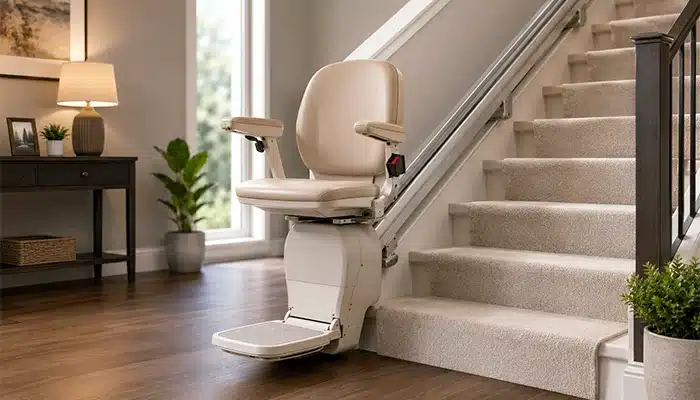
Stairlifts and inclined platform lifts follow the same movement trajectory, but stairlifts have a simpler structure. It holds the seat on the rails, and a motor drives the wheelchair to move along the direction of the stair railing.
Pros
Small house renovation:Installed on the side of the stairs, it does not require digging a pit or altering the wall structure, nor does it damage the original stair structure.
Small footprint: The stair lift platform is in the form of a regular seat, which is small in size and occupies only a small amount of space on one side of the stairs.
Short installation time: Its structure is simple and can be installed in a few hours or a day.
Relatively low cost: Due to its simple and single structure and function, the price is lower than that of home elevators and vertical platform lifts.
Low energy consumption: Stairlift chairs consume relatively little electricity.
Increased mobility: It makes it easier and safer for elderly people who are mobile but have deteriorating balance to go up and down stairs.
Cons
First, stair lifts are not convenient for wheelchair users to use independently; they require assistance, which is time-consuming and troublesome.
Secondly, stairlift chairs can only be installed on one stairwell, and are ineffective for multi-story buildings.
Third, steeper stairs are less comfortable to ride and are prone to derailment, which can cause injury to users.
Fourth, it lacks aesthetic appeal; it resembles a medical device and cannot blend into a well-designed residential style.
Fifth, it can only be used by one person at a time, and there are weight restrictions for the user, usually 120-140kg.
Finally, for irregular staircase structures, customization is expensive and maintenance is complex.
Applicable Scenarios
It is suitable for underground garages with stairs.
Railings & Grab Bars
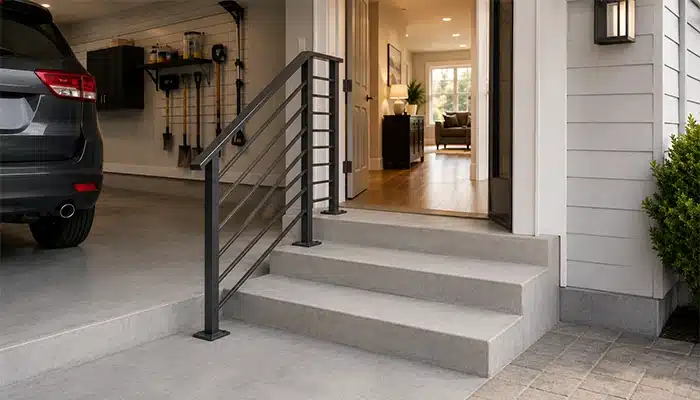
Railings and grab bars are the simplest accessibility devices, installed on both sides of stairs and walls, mainly serving a simple support function.
Pros
The most significant advantage of railings and grab bars is their low price, making them suitable for families with limited budgets who want to provide convenience and safety for elderly people with mobility issues. In addition, railings and handrails can usually be used for many years, making them very economical and effective accessibility equipment.
Cons
Compared to other accessible facilities, railings and grab are purely physical assistive devices with low convenience, requiring users to have mobility. Furthermore, railings and grab do not truly solve the problem of going up and down stairs; stairs are still required, which can easily cause falls for elderly people with poor balance.
Applicable Scenarios
This applies to any building with a garage and a height difference between the ground floor and the garage.
Wheelchair Ramps for Garage
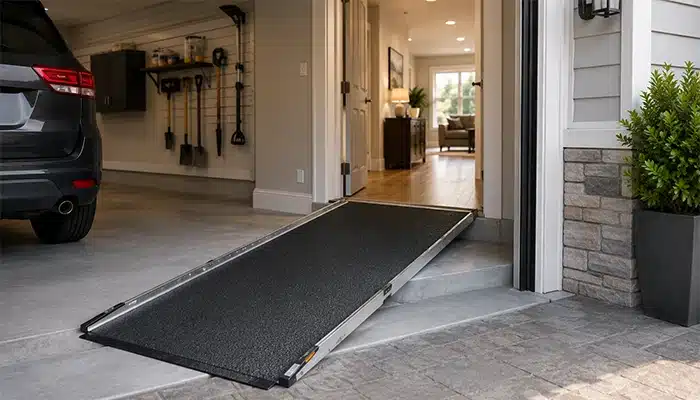
An accessible alternative to stairs, garages, and indoor floor height differences. Sloping ramps can be constructed using cement, brick, or stone, or as mobile temporary ramps made of aluminum alloy.
Pros
Ramps are the safest access routes. They are purely structural facilities, with no mechanical failures, no need for power, and no power outage issues. In addition, ramps can be customized according to your floor height difference and specific circumstances, enabling truly barrier-free access.
Movable ramps are suitable for a variety of scenarios and can be used interchangeably in garages, residential entrances, and courtyards.
Cons
If a fixed concrete ramp is to be built, the requirements for the civil engineering structure are high, and it is necessary to plan the drainage system, adjust the threshold, and redo the concrete structure, etc. In addition, ramps are not “zero-physical-intensity facilities.” When using a wheelchair, going uphill requires continuous reasoning, and going downhill requires controlling speed, which is not convenient enough for the elderly and people with insufficient independent mobility.
Applicable Scenarios
It is suitable for residential or light commercial spaces with sufficient space and low ground level difference.
Conclusion
Each of the above solutions can reduce the difficulty of entering and exiting your garage. However, if you are unsure which option is right for you, please consult a home accessibility expert or listen to our professional recommendations below.
Why Choose Anter?
For users seeking ultimate convenience and a long-term barrier-free experience, home elevators and vertical platform lifts are often considered the most comprehensive solutions. Current technology is very mature, and your pain points can be solved by different manufacturers. These two products account for the largest share of the market for accessible family homes. According to industry estimates: home elevators account for 40%-60% of the market share, while vertical lifting platforms account for 30%-50%. Compared to other accessible devices, they offer the best in terms of convenience and functionality.
Anter – a manufacturer with over 16 years of experience – can provide you with home elevators and vertical lifts that offer the advantages mentioned above. We offer robust, stable, and comfortable lifting equipment, along with attentive and considerate service throughout the entire process.
Whether it’s a new or old house, whatever your needs, we respond quickly and provide tailored solutions to ensure that the equipment integrates seamlessly into your home. Please contact us!
Success Stories about Us
Anert is honored to serve every customer. Let’s listen to our satisfied customers share how they achieved a more convenient travel experience. Their cases validate the positive impact of our products and services.
3-story Traction Home Elevator Renovation
There is a height difference between our garage and the interior. We initially considered building a ramp, but there wasn’t enough space. We ultimately chose a home elevator, and now getting in and out is very smooth, and it doesn’t take up parking space. —-Sarah J.
2-story Hydraulic Home Elevator Installation
After installing a home elevator in the garage, it’s become very convenient to go out with the elderly and children. In particular, my parents are no longer dependent on others, and their independence has greatly improved. — David R.
Home-based Elderly Care Planning Using Vertical Lifting Platforms
After the vertical platform lift was installed, my mother’s life became much easier. She can now go up and down the stairs by herself without worrying about falling. —Michael T.
Faq
How to install a home elevator in my garage?
Home elevator installation is usually done by professional technicians. You just need to ask your elevator manufacturer if installation services are included or contact your local installer. If you would like to learn more about the detailed installation process of a home elevator, you can click here 👉Comprehensive Installation Process of Home Elevator👈.
What is the best accessibility solution for a garage entrance?
There is no perfect solution, only the most suitable one. Home elevators, platform lifts, stair lifts, ramps, handrails—each can become a convenient mobility tool in your garage. You should evaluate and make your choice based on the actual space, budget, user situation, etc., and consult accessibility solutions experts if necessary.
Are home lifts expensive to install and maintain?
Compared to other accessible devices, home elevators are indeed expensive. However, it can be used by the whole family, offering high convenience, enhancing the value of the house, and has a long service life, making it a mid-to-high-end upgrade investment in home renovation. In the long run, the value brought by home elevators far exceeds the cost of purchasing them.
When is a ramp not suitable for garage accessibility?
- There is not enough installation space in the garage.
- When the height difference between the garage floor and the indoor floor is significant.
- Install in areas with poor drainage or that may be susceptible to rainwater erosion.
- If the user has severe mobility issues, it is recommended not to use the ramp.
What are common mistakes when choosing a garage accessibility solution?
- The lack of actual measurement and assessment of the proposed installation location led to errors in the data communicated with the vendor.
- Choosing a garage accessibility solution solely to save costs.
- The user’s mobility was not fully considered.
- Environmental changes at the reserved locations were not considered.
 English
  Arabic
  Vietnamese
  German
  Malay
Malay  Thai
Thai