
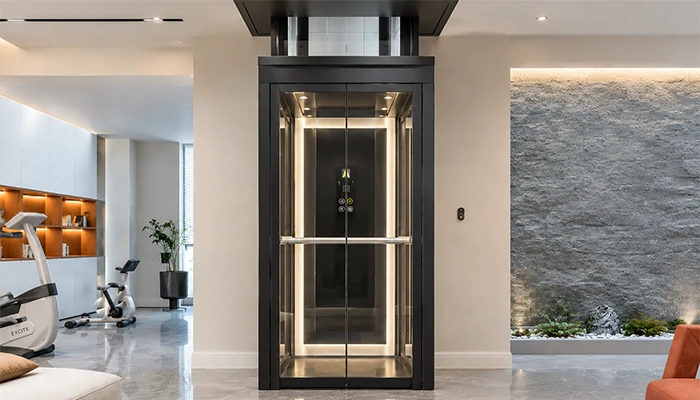
Compact home elevators are comprehensive solutions designed for extremely limited installation spaces, featuring optimized frame structures, door operating mechanisms, and shaft layouts. Many models can be paired with an integrated glass shaft, eliminating the need for a pre-constructed civil engineering shaft.
If you are evaluating compact home elevators for a project or business venture—considering factors such as dimensions, costs, or ideal installation scenarios—the following information will help you develop a systematic understanding.
Typical Dimensions and Specifications for Compact Home Elevators
The core design objective of a compact elevator system is to ensure a safe, functional space for passengers within an extremely small footprint. Most mainstream compact traction elevators on the market are designed to accommodate one or two passengers at a time; the car dimensions are typically around 700 × 800 mm, with an overall footprint of 1,000 × 1,000 mm.
If a household requires wheelchair accessibility, the elevator car must have minimum dimensions of 900 × 1,200 mm, with an overall footprint of at least 1,300 × 1,400 mm. Furthermore, options for compact, wheelchair-accessible home elevators are significantly more limited; it is essential to verify the clear door opening width and the internal dimensions of the car in advance. Most ultra-compact models do not provide sufficient space for a wheelchair to enter or exit.
Many compact elevators on the market come with an integrated aluminum alloy glass shaft. The shaft frame, glass railings, and elevator equipment are integrated into a finished product, eliminating the need for the owner to pour concrete for the shaft in advance. The overall footprint is usually between 0.8㎡ and 1.5㎡.

Suitable Installation Scenarios for Compact Home Elevators
✅ Scenario 1: Retrofitting an elevator into an established, older villa—no elevator shaft was provided during the original construction, leaving only a small, narrow void within the stairwell.
✅ Scenario 2: There is only a narrow, unused space in a corner of the detached villa, and there is no room for a standard-sized residential elevator near the living room or staircase.
✅ Scenario 3: You would like a glass sightseeing home elevator, but have limited space available; you prefer a minimalist, transparent aesthetic and want to ensure the elevator does not take up too much interior floor area.
❌ Less suitable scenarios: Households where the elevator is frequently used by multiple people at once, or where there is a long-term, high-frequency need for wheelchair accessibility. The interior space of a compact elevator cabin is limited; it becomes crowded when occupied by several people simultaneously and cannot easily accommodate both a wheelchair and an accompanying caregiver.

Cost of Compact Home Elevators
Compact home elevators kits feature a custom-engineered design optimized for specific requirements; unlike standard elevator models, which can be mass-produced, these units are available in fewer standardized configurations. Consequently, the per-unit cost is generally somewhat higher than that of a conventional home elevator serving the same number of floors. The global average price is approximately US$6,000–12,000.、
Although the unit price of the equipment is higher, the compact, integrated glass shaft solution eliminates the significant construction costs associated with pouring a concrete shaft or modifying existing walls.
For some renovation projects involving older properties, the costs for structural modifications can be extremely high—reaching as much as $60,000. In such cases, opting for a comprehensive, compact, pre-fabricated solution often proves to be more cost-effective.
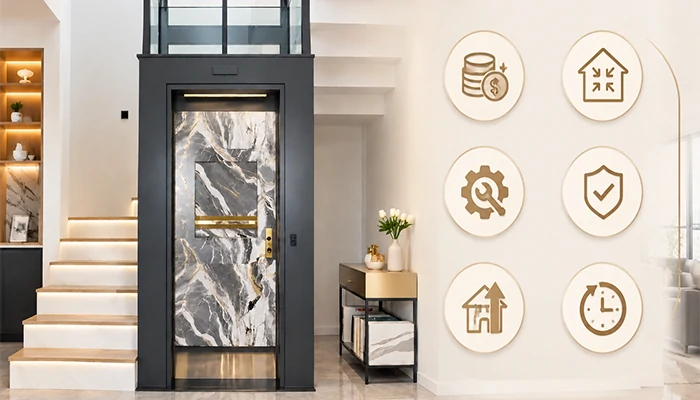
Key Pitfalls to Avoid During Selection
When choosing a compact elevator for home, do not be swayed solely by a sleek, small appearance; prioritize verifying that it comes with a full suite of safety features. Many merchants highlight an ultra-compact design as a key selling point, often simplifying or omitting safety components—such as speed-limiting devices, brakes, and buffers—to save space.
There can be no compromise on the safety baseline for passenger elevators; models with simplified safety components pose a higher risk when used in a residential setting over the long term.
As a home elevator company with extensive industry experience, when handling orders for compact-sized units, we exclusively recommend traction-based elevators that feature comprehensive safety configurations and ample safety margins. The core safety components in these models are identical to those found in our standard home elevators; we never compromise on safety features in order to reduce the unit’s dimensions.

FAQs
Can a compact home elevator be installed outdoors?
Yes, there are compact traction elevators specifically designed for outdoor use. These come with waterproof and corrosion-resistant aluminum alloy shafts, as well as protective electrical components for outdoor environments. However, because outdoor models require higher standards for sealing and waterproofing, the total cost is higher than that of indoor versions.
What is the maximum number of floors a compact elevator can serve?
Mainstream compact traction-type lifts reliably support 2–4 floors; however, for greater lifting heights, the complexity of the structural frame design increases significantly, resulting in very few available models on the market and limited support for maintenance and servicing.
What is the average cost of maintaining a home elevator?
Home elevators typically require professional maintenance only once or twice a year; you can enter into an annual maintenance agreement with a professional service company. The cost for a single maintenance visit is approximately 100–200, while the average annual maintenance cost is around $800.
Does Medicare pay for a home elevator?
Generally, Medicare does not cover the purchase and installation costs of a home elevator, as it is not classified as durable medical equipment. However, there are other avenues that may help offset some of these expenses, such as Medicare Advantage (Part C), Medicaid, or state and local programs that support accessibility modifications.
What are the common problems with home lifts?
Thanks to continuous technological improvements, home lifts are now very safe. However, this does not mean that they are entirely immune to issues.
Common issues with residential elevators include the following categories:
- Malfunctions of the elevator car doors and landing doors
- Power and electrical faults
- Problems related to vertical travel between floors
- Reduced ride comfort
- Drive system issues (particularly in hydraulic elevators, where prolonged use without maintenance can lead to hydraulic fluid leaks)
- Communication system failures
These issues can be effectively avoided by choosing a reliable home elevator company and ensuring regular maintenance.
Final Thoughts
Compact home elevators are an excellent retrofitting solution for villas with limited space, but they are not a universal fix suitable for every household.
You can begin by measuring the dimensions (length and width) of your intended installation site, noting the number of floors, and considering your daily usage requirements; this will help determine whether a compact-design elevator is the best choice.
If you have the site measurements, please contact us. Anter can provide a proposed floor plan layout for a compact traction-driven home elevator tailored to your specific conditions.
 English
 Arabic
 Vietnamese
 German
 Malay
 Thai