
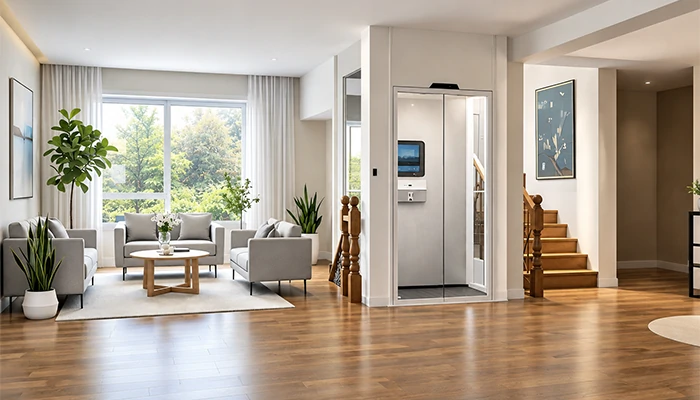
The market for home elevators overseas is a mixed bag, ranging from original manufacturers—which possess their own production facilities, R&D capabilities, and the expertise to refine technical drawings—to mere trading intermediaries who simply flip products through multiple layers of resale.
Drawing on our extensive experience in working with clients across the globe, we would like to share several key dimensions for vetting suppliers.
Verify The Alignment Between The Company’s Main Product Line And Your Envisioned Solution
First, identify the manufacturer’s core product offerings to see if they specialize in the specific type of home elevator you intend to purchase.
If you are planning to purchase a traction-driven home elevator, prioritize manufacturers that focus on traction elevators as their core product line. If a supplier’s primary business lies in other types of elevators—with their traction models merely being rebranded, outsourced products—their technical expertise and quality control capabilities are likely to be significantly weaker.
Next, verify the supply chain for critical safety components—such as the traction machine, control system, speed governor, and safety gear. Determine which brands are used for these essential safety parts, and confirm whether the corresponding factory certificates and inspection documentation can be provided.
Safety components are the foundation of a passenger elevator. No matter how attractive an elevator’s exterior may be or how low its price, skimping on core safety components creates significant long-term risks.
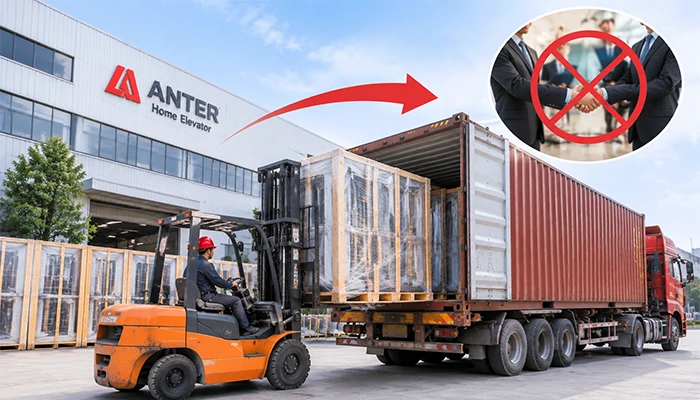
Verify The Factory’s Delivery Capability and Avoid Middlemen
When communicating with different suppliers, you can proactively ask them the following questions. This will help you quickly distinguish between original manufacturers and intermediaries:
- Is it possible to provide actual footage of workshop production, the pre-shipment inspection process, and inventory/scheduling information?
- Evaluate their technical detailing capabilities: Can they provide—based on your specific civil engineering dimensions—customized elevator shaft layout drawings, civil work requirement specifications, and load data?
- Experience with export projects: Are there any completed projects in the same country involving similar types of villa elevators? Is the provider familiar with the specific requirements for export packaging, freight, and customs clearance?
The vast majority of intermediaries lack the capability to refine technical drawings, often simply passing on generic, off-the-shelf designs. Should discrepancies arise between the actual site conditions and these drawings, there are no engineers on hand to adjust the plans; this frequently leads to uncontrollable project timelines and sluggish responses when technical issues emerge later on.
Technical Support And A Long-Term After-Sales System Are Crucial
A home elevator is not a one-off, disposable product; following its delivery, it requires ongoing support—including installation guidance, the supply of spare parts, and long-term maintenance—that spans over a decade.
For overseas procurement clients, this is particularly important: can the supplier provide complete technical manuals, installation drawings, and remote video-based technical guidance in English? Furthermore, can spare parts be exported separately, and what is the lead time for replenishment?
Many low-cost suppliers focus on selling equipment; once the sale is complete, the original manufacturer may discontinue or stop supplying spare parts. Consequently, when an elevator breaks down, the owner is unable to find replacement parts, leaving the elevator out of service for an extended period.
Item-by-Item Verification of Quotations And Contract Details
A reliable supplier will always provide a price quote with a clear breakdown of individual items—such as the elevator main unit, shaft framework, optional decorative features, packaging and shipping, and any available upgrades—all listed separately.
Providing a quote that lumps various vague items together is a common way to hide traps, often leading to a stream of unexpected additional charges later on. Therefore, before signing the contract, be sure to clarify the scope of the quoted price: identify which items are included as standard and which are optional add-ons, and determine which components are covered by the warranty versus which wear-and-tear parts are excluded.

FAQs
Should I purchase from a local trading company or directly from an overseas factory?
Each approach has its own advantages: local trading companies offer the benefit of on-site installation and faster response times for maintenance and support.
Direct-from-factory pricing offers a clear cost advantage, making it an ideal option for contractors and distributors who have their own installation teams. End-user clients who purchase directly from the factory will need to independently arrange for local installation services.
How can you determine whether the completed projects showcased by a business are genuine?
You can request that the vendor provide actual on-site footage, relevant elevator shaft drawings, and records of project-related communications.
Many unscrupulous intermediaries—who often steal images from elsewhere—can only offer renderings downloaded from the internet and are unable to produce the corresponding technical documentation.
Does a higher price necessarily mean better home elevator quality?
Not necessarily; high price tags often include a brand premium and markups from intermediaries.
Conversely, a price significantly below the standard market range very likely indicates cost-cutting on core components or safety features. Such equipment poses a high safety risk, so it is ill-advised to blindly opt for the lowest-priced option.
How much does it cost to install an elevator in a residence?
The equipment cost for a home elevator typically ranges from $3,000 to $20,000, while installation costs generally fall between $2,000 and $8,000, depending on site conditions. For new construction, installation costs tend to be on the lower end—averaging around $3,000—whereas for renovation projects in existing homes, the costs can exceed $8,000.
What are the best home elevator companies for residential use?
There is no such thing as an “absolutely best” home elevator company; any company that can meet your specific needs is a good one. Following the steps outlined in this article will help you avoid many unnecessary problems.
Final Thoughts
In short, when selecting a home elevator supplier, the order of priority should be: safety features and certifications > technical drawing and engineering capabilities > delivery and after-sales support > product price.
If you are looking for a primary manufacturer of traction or hydraulic home elevators, you can contact Anter.
We can provide you with comprehensive component qualification documentation, examples of completed villa projects worldwide, one-on-one technical drawing refinement, and full-scale export support. Please let us know your project requirements, and we will do our utmost to meet them.
 English
 Arabic
 Vietnamese
 German
 Malay
 Thai