
When undertaking an accessibility renovation project for a villa, if you find that the open space in the center of the staircase is very small or the designated corner space is cramped, a compact home elevator can provide the solution.
Furthermore, if you happen to be in the budget-assessment phase of a residential project, it is crucial to understand the costs associated with small home elevators. Drawing on our extensive market experience, this article outlines typical price ranges for such elevators, the factors that influence these costs, and potential pitfalls to watch out for—all to help you make an informed decision.
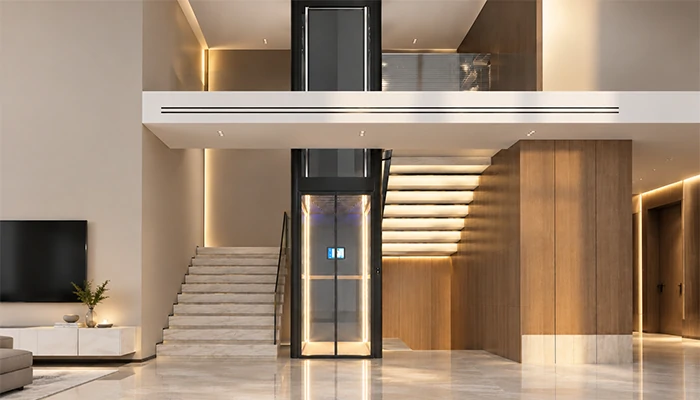
Reference Price Range for Mainstream Small Home Elevators
There are two distinct options for small residential elevators: installation within an existing structural shaft, or the use of a self-contained, integrated aluminum-alloy and glass shaft. The cost difference between these two approaches is substantial—a point that often leads to confusion or misinformation when obtaining price quotes.
For a small, two-story residential elevator—provided that a compliant elevator shaft, pit, and sufficient overhead clearance are already in place—a basic traction home elevator offers excellent value for money, with an average market price ranging from $5,000 to $12,000 USD. As the floors increase to three and four floors, the lifting height becomes larger, and the guide rails, steel belts, and host power are upgraded simultaneously, the overall cost will rise steadily, and the final price range will be between $11000-$22000.
If no elevator shaft was incorporated into the building’s original structural design, a prefabricated aluminum-alloy and glass shaft must be installed. The costs for the frame, tempered glass, sealing components, and weatherproofing accessories are calculated separately, bringing the total price for this configuration to approximately 3,000–8,000 higher than that of a built-in structural shaft.
In addition, the bare metal purchase price of small hydraulic elevators is generally lower than that of traction models under the same size and floor conditions. The price of a basic hydraulic small elevator is approximately US$3,000-8,000.
However, long-term energy consumption, seal replacement, hydraulic oil replacement and other subsequent expenses must be included in the full cycle cost, and we cannot just look at the one-time purchase price.
Key Factors Contributing to Price Differences in Small Home Elevators
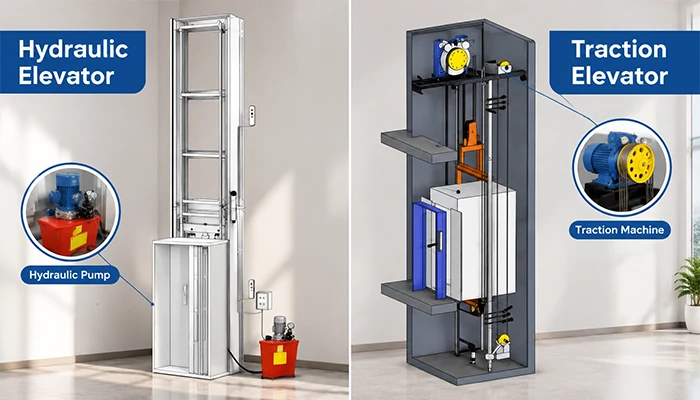
Drive Types
Traction small elevators offer smooth, quiet operation and low long-term energy consumption, while featuring highly standardized maintenance parts; consequently, they are the most popular choice among overseas villa owners. Their downside lies in strict requirements regarding civil engineering specifications, specifically the need to allocate space for the counterweight.
Small hydraulic elevators are well-suited for specialized settings with limited floor-to-ceiling height or extremely small elevator shafts. While they offer a lower initial purchase cost, they entail higher energy consumption over the long term; furthermore, as seals age, there is a risk of leakage, and ongoing maintenance costs tend to be higher.
Car Finishes and Flooring Configuration
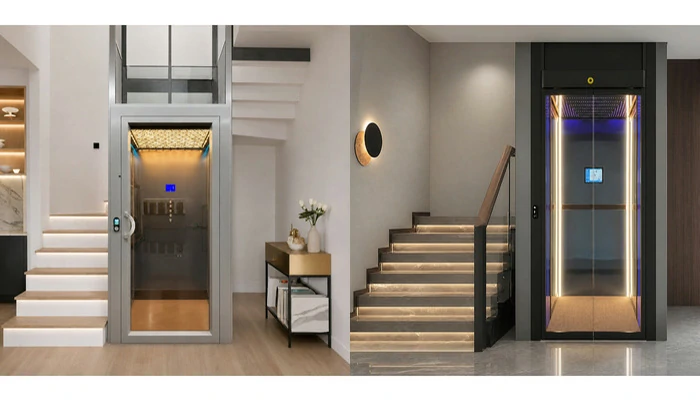
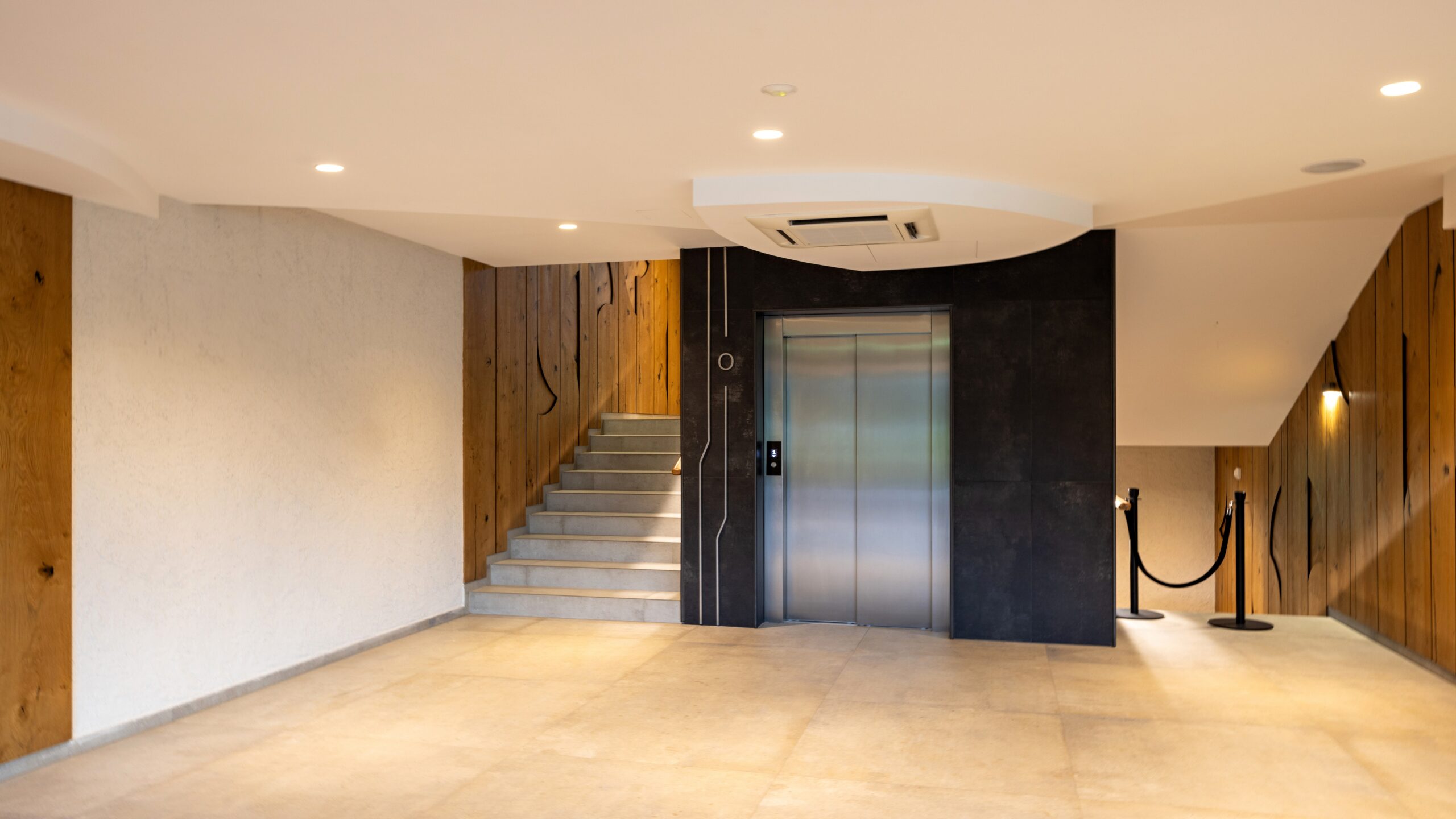
The entry-level configuration features a PVC non-slip floor and a simple powder-coated steel cabin, offering a cost-effective, basic solution. Options for features such as sintered stone or marble flooring, mirrored stainless steel walls, or a fully glazed panoramic cabin will lead to a significant increase in both material and processing costs.
Furthermore, many small-scale panoramic elevators—due to their compact structural frames—require more complex glass cutting and sealing techniques, resulting in a more pronounced price premium compared to standard panoramic elevator models.

Door Opening Design Scheme
For standard home elevators, manually operated doors are the preferred choice; they offer a wider opening and feature a well-established, reliable design. Many property owners opt for automatic (power-operated) doors, but these require custom-made door mechanisms rather than mass-produced, off-the-shelf components. Since both the door mechanism and the door panels must be custom-fabricated, this entails additional customization costs.
Common Budget Pitfalls When Purchasing a Small Home Elevator
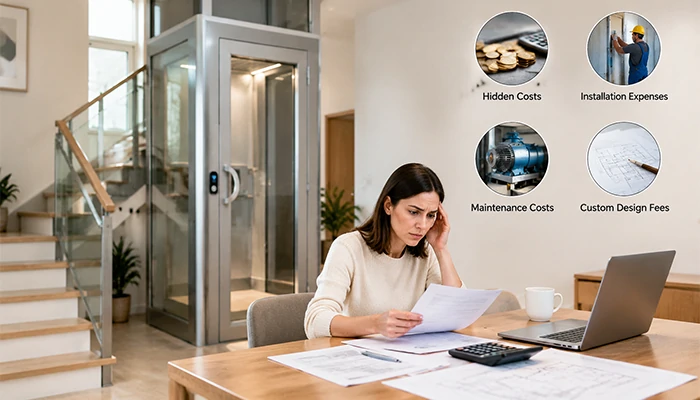
Trap 1
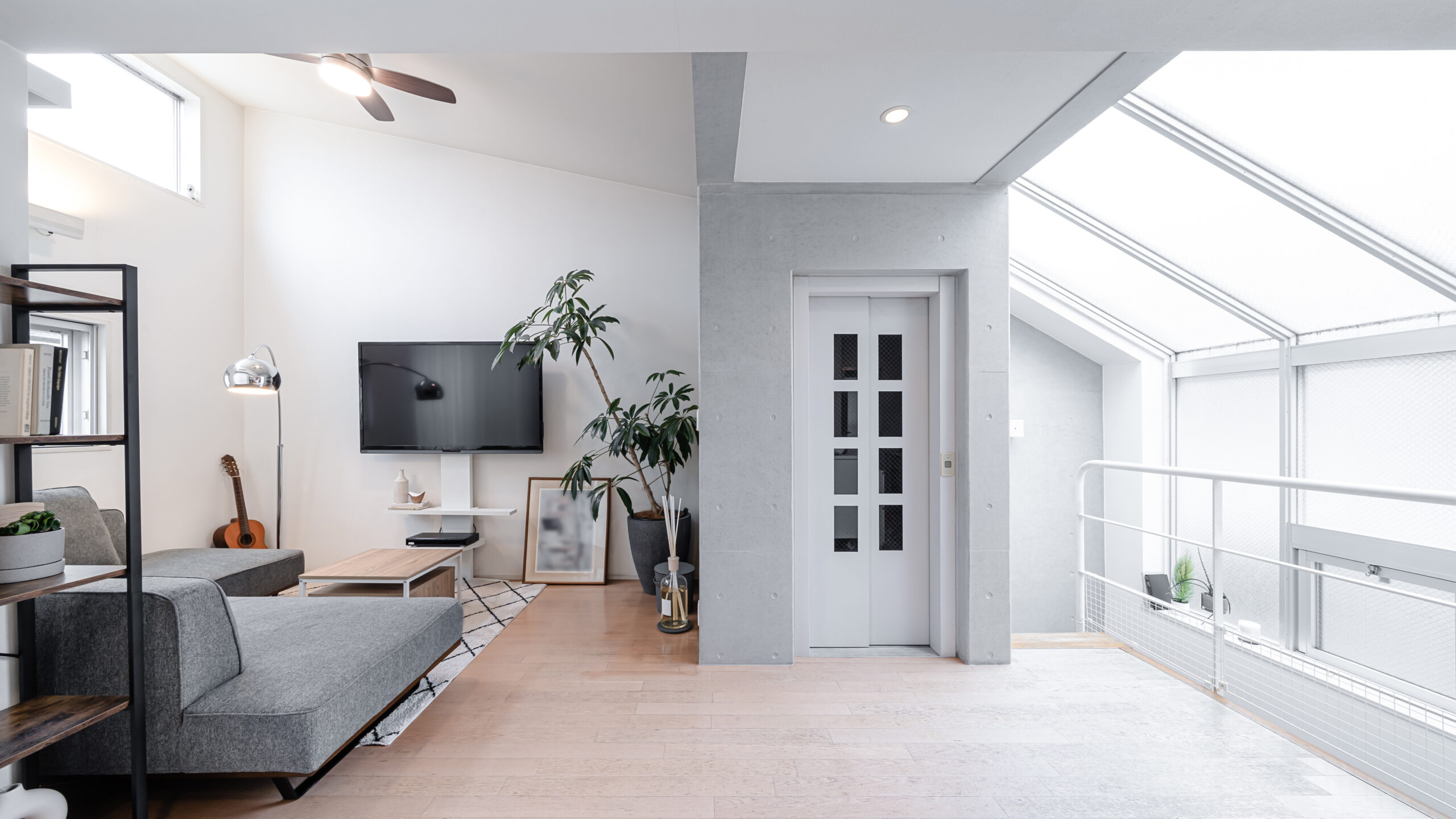
Comparing only the price of the equipment itself—while overlooking on-site installation conditions—can be misleading. For instance, if the installation site is a shaft enclosed by three walls, the elevator can be installed directly within it without the need for additional exterior cladding; this represents the most cost-effective solution.
However, if you are installing the elevator in the middle of a staircase or against one or two walls, you will need to account for the finishing work required after the installation is complete. Since the elevator necessitates an enclosed shaft for safety, this exterior finishing represents an additional cost.
Trap 2
Prioritizing extreme miniaturization at the expense of safety margins. In an effort to market their products as “ultra-compact,” some suppliers reduce safety clearances within the chassis and opt for stripped-down safety components.
Passenger elevators are equipment where safety is the top priority; excessively compacting their structure compromises long-term stability, makes it difficult to source compatible replacement parts later on, and leaves maintenance providers unable to find standard, interchangeable components.
When handling projects, we prioritize matching suitable compact solutions within the limits of safety standards; we do not sacrifice safety margins merely for the sake of a “small-size” gimmick.
Trap 3
Most standard small-scale home elevator components are universal. In contrast, highly customized, niche, or non-standard small-sized models rely on parts that are rarely available on the market; should any component fail, replacements are difficult to source, lead times are long, and individual parts are expensive—all of which drive up long-term maintenance costs.
FAQs
Do small, two-story traction-type home elevators offer greater stability and a higher level of technical maturity?
Yes, for a two-story villa, a small traction elevator is currently the most mature technical solution; it benefits from a stable supply chain, readily available spare parts, and superior noise control. It is well-suited for long-term residential use and is also the type we deliver most frequently in our projects.
Is it mandatory to install a separate glass shaft for a small elevator?
Not necessarily. If your home already has a structurally sound, appropriately sized shaft—built as part of the original construction—you can install the elevator directly within it. This saves a significant amount on the costs of constructing a shaft frame and glass enclosure, making the budget much more manageable.
Glass shafts are typically used in scenarios such as retrofitting elevators into older villas where no shaft was originally provided.
Is the ongoing maintenance for a small-sized elevator significantly more expensive than that for a standard-sized one?
If you choose a standardized, small-scale traction-type model, its core components are the same as those used in standard elevators, meaning there is little difference in maintenance costs.
Conversely, if you opt for a highly customized, specialized, or unusually narrow model—the kind rarely seen on the market—the costs for sourcing replacement parts and performing repairs will be significantly higher.
What Is the Standard Small Home Elevator Size?
Typical dimensions for small residential elevator cabins range from 700 × 800 mm and 800 × 800 mm to 900 × 1200 mm, with an overall footprint of approximately 1000 × 1000 mm to 1400 × 1400 mm.
If you are unsure about the required elevator dimensions, please contact us; our professional engineers can conduct an on-site assessment and provide a customized solution tailored to your needs.
What Is the Typical Installation Time Frame for a Small Home Lift Elevator?
The installation of a simple, small home elevator can typically be completed in 3–7 days. However, the exact time frame depends on site conditions, the elevator’s configuration, and the number of floors. More complex installations—such as circular panoramic elevators—may require 10–15 days.
Final Thoughts
The cost of a small home elevator is never determined solely by the size of the car; rather, it is the cumulative result of factors such as the drive system, shaft configuration, car interior finishes, door opening mechanism, and any additional requirements.
If you have limited indoor space in your villa and are planning to install a small home elevator, please provide us with details such as the dimensions of the elevator shaft opening, the number of floors, whether wheelchair accessibility is required, and whether a structural elevator shaft is already in place. Anter engineers will then assess your site conditions to recommend a suitable, compact traction-type elevator solution that incorporates a generous safety margin. At the same time, we will give you clear itemized quotations to avoid hidden price increases.
 English
 Arabic
 Vietnamese
 German
 Malay
 Thai