
Wheelchair lifts provide wheelchair users with a convenient travel solution, allowing them to access bedrooms, living rooms, gardens, parks, and other places without barriers.
Most homeowners who want to own a wheelchair lift want to know its price in advance. Therefore, here we have listed the price range for wheelchair lifts in 2026, and below we detail the main factors that affect the price of this equipment so that you can set a reasonable budget.
| Type | Portable Lifts | Residential Vertical Platform Lifts | Inclined Platform Lifts |
| Cost | $750-$5000 | $12,000-$30,000 | $15,000-$30,000 |

What Is a Wheelchair Lift?
A wheelchair lift is a small, electric lifting device designed specifically for wheelchair users or elderly people with mobility issues. It allows users to safely navigate floors, thresholds, steps, and other areas without leaving their wheelchairs.
Wheelchair lifts can be classified into three types based on their purpose and installation method: porch lift, residential vertical platform lifts, and inclined platform lifts.
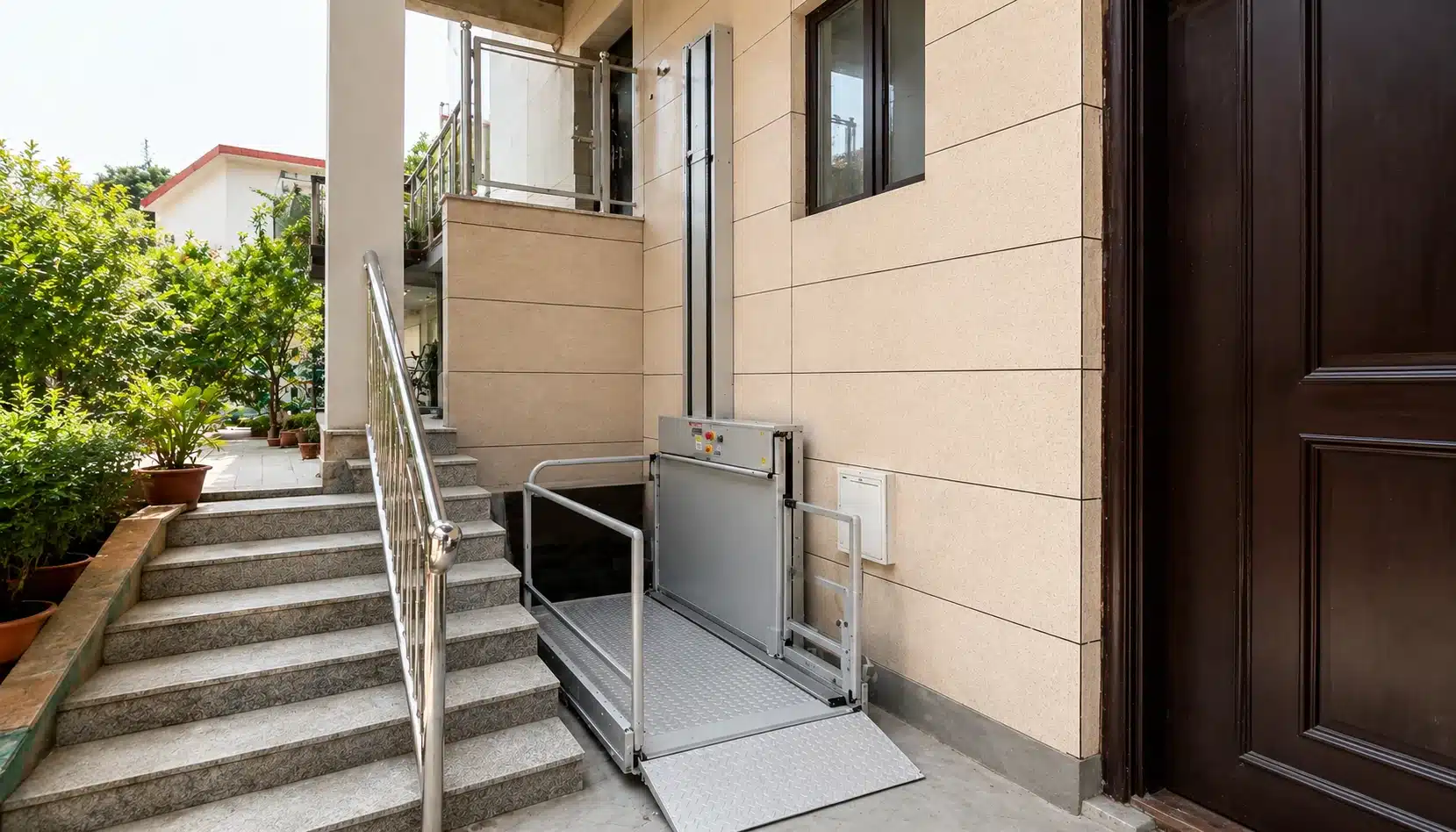
Porch lift:A porch lift is an open-accessible device with a travel distance of only 1-3 meters, typically used to help wheelchair users and the elderly cross long ramps or stairs.
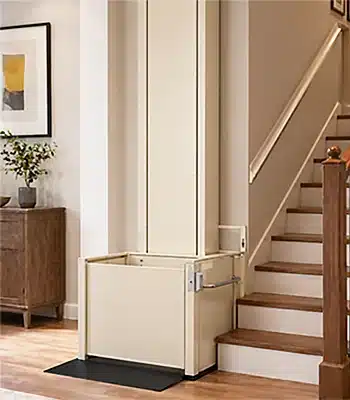
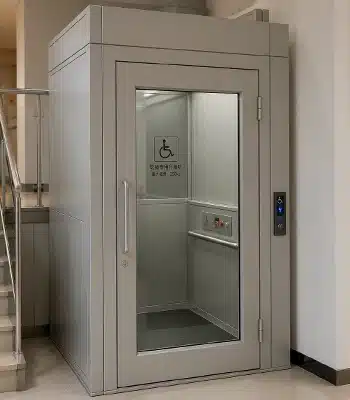
Residential Vertical Platform Lifts: Residential vertical platform lifts come in both enclosed and semi-enclosed appearances. The device has a high travel range, reaching 2-4 floors. Furthermore, its structure is similar to that of a regular home elevator.
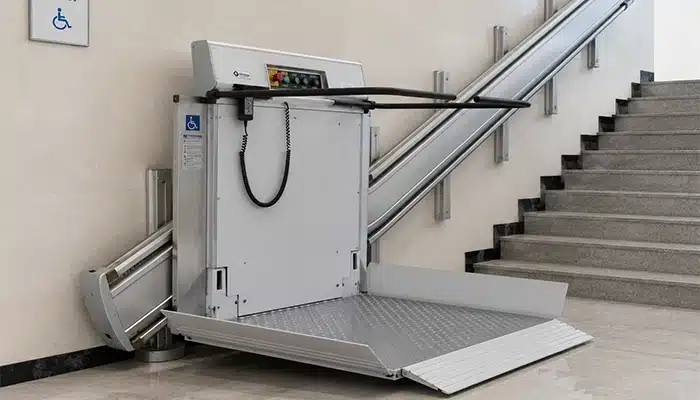
Inclined Platform Lifts: Inclined platform lifts are often called stair lifts because the platform runs along guide rails fixed to one side of the stairs. Users can go up and down the stairs directly using the staircase structure.
Factors Affecting the Cost of Wheelchair Lifts
Installation Location
Porch Wheelchair Lift
Wheelchair lifts installed in the porch are cheaper than those installed indoors. The porch lift only requires a small concrete base, which is fixed to the ground/stairs. There is no need to build a shaft, demolish walls, or damage floors, resulting in low construction and installation costs.
Garage Wheelchair Lift
Garage wheelchair lifts are typically more expensive than porch lifts, but cheaper than indoor wheelchair lifts.
First, garage wheelchair lifts have higher requirements for the ground and foundation, requiring confirmation of the thickness, load-bearing capacity, and integrity of the concrete floor.
Secondly, garage wheelchair lifts are semi-outdoor equipment, used more frequently than outdoor equipment, therefore requiring a higher-grade motor. Furthermore, the garage is dusty and has a lot of car exhaust, so it also requires high-level protection for the electrical control box.
Finally, garages are generally within the range of household electrical standards. If a wheelchair lift is to be used, some simple electrical modifications are required, such as: a professional circuit, an air switch, and grounding protection.
Balcony Wheelchair Lift
Wheelchair lifts installed on balconies are relatively more expensive. This location primarily presents challenges in terms of installation difficulty, protection, and structural support.
First, since the balcony does not have the same solid foundation as the ground, it is necessary to assess the load-bearing structure and add additional support if necessary.
Secondly, installing a stair lift on a balcony is more difficult, requiring waterproofing and corrosion prevention, and in some cases, drilling through the floor slab is necessary. This installation location requires more meticulous planning and more professional installation techniques.
Finally, the location of the balcony places more stringent requirements on the height of the lift and the structure of the passageway. It requires longer guide rails and a more powerful motor to ensure it can reach balconies at higher locations.
Indoor Wheelchair Lift
The price of wheelchair lifts installed indoors is higher than that of those in porches or garages, but lower than that of some complex outdoor high-travel installation scenarios.
Interior design needs to be both functional and aesthetically pleasing, which may increase customization costs. Furthermore, many indoor installations require drilling holes in the floor slab, reinforcing the ground, adjusting the walls, and modifying the electrical circuits.
Comfort is also one of the core focuses of indoor stair lifts, so indoor models have higher equipment configurations.
Travel Height
The most common travel distance for home wheelchair lifts is 3–5 ft (0.9–1.5 m), and the price increases significantly for lifts exceeding 6 ft. Prices almost double for items larger than 10 feet.
The higher the travel distance of a wheelchair lift, the higher the requirements for structural materials, such as thicker and wider guide rails, base, and columns, as well as greater wind and torsional strength.
In addition, wheelchair lifts require more advanced, higher-powered motors to drive the platform to higher positions. At the same time, the requirements for installation devices are also higher, requiring the installation of safety doors, door interlocks, emergency stops, and fall protection devices.
Platform Size
The larger the platform size, the higher the price. Increasing the platform size requires more steel, aluminum, or composite materials to support the weight. Furthermore, to accommodate the increased size and weight of the platform, the motor power of the guide rails and lifting structure needs to be increased, and the structure also needs to be reinforced.
Weight Capacity
Load capacity is one of the most important factors that directly affects the price of wheelchair lift platforms.
The most common home wheelchair lifts have a load capacity of 340kg, with the largest reaching 450kg, while public lifts can carry up to 600kg.
The greater the load capacity of a wheelchair lift platform, the more its structural strength, motor power, control system, and safety device configuration need to be. Note that the load capacity is highly correlated with the platform size; usually, as one increases, the value of the other will also increase accordingly.
In addition, load capacity will affect long-term maintenance costs. The greater the load, the faster the machine wears out, thus increasing the frequency and cost of maintenance.
Custom Features
Wheelchair lifts are customizable products that can be designed and manufactured to suit your style and location.
Customization of wheelchair lifts includes exterior customization: glass panels, special colors, wood grain trim, stainless steel materials, etc.
Customizable features include: automatic doors, remote control operation, folding platform, backup battery, voice prompts, etc.
Special installation environments can also lead to increased customization costs: such as narrow staircases, irregularly shaped spaces, and renovations of old houses.
Wheelchair Lift vs Home Elevator Cost
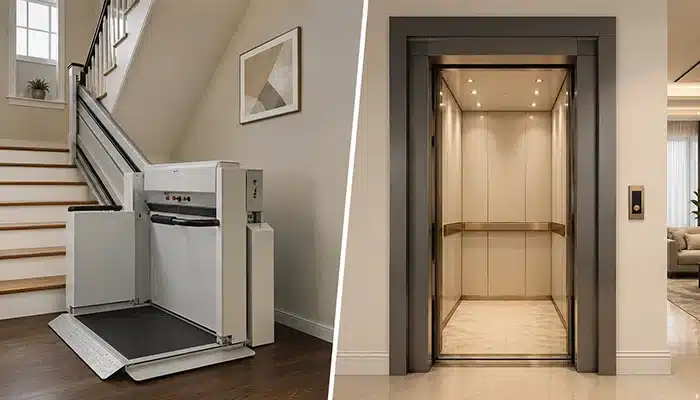
| Feature | Wheelchair Lift | Home Elevator |
| Average Cost | 5000$-20000$ | 5000$-80000$ |
| Installation Cost | 1500$-5000$ | 10000$-20000$ |
| Operating Cost | Lower | Higher |
| Annual Maintenance Cost | 500$-700$ | 800$-1200$ |
| Budget Suitability | Better for limited budgets | Better for long-term luxury investment |
Additional Costs Homeowners Often Forget
In addition to the equipment costs, installation costs, and maintenance costs mentioned above, you should also be aware of the following potential additional costs.
Electricity Costs
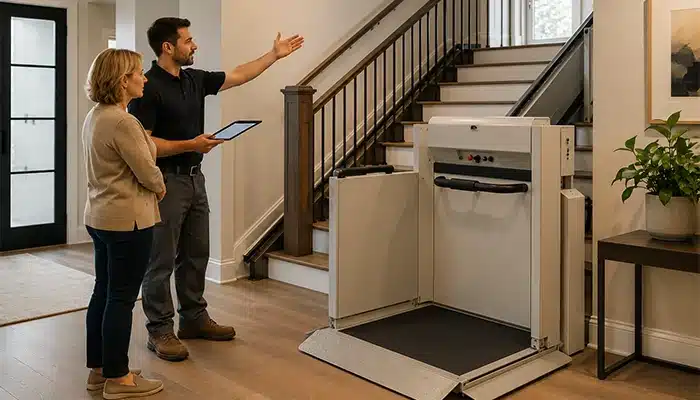
Wheelchair lifts require electricity to operate and charge backup batteries, which incurs electricity costs. However, since stair lifts have relatively low power, typically 0.2-0.5KW, the annual electricity cost for a typical stair lift is only a few tens of dollars.
Insurance Costs
Wheelchair lifts are an important part of a family’s property, and homeowners can purchase insurance for them to cover various unforeseen circumstances such as fire, lightning strikes, theft, malicious damage, and accidental collisions.
Upgrade or Modification Costs
If the homeowner is moving or wants to upgrade their current stairlift with more advanced features, they will need to pay an additional cost for this feature. The cost of an upgrade or modification typically ranges from $500 to $3,000, but the exact price needs to be determined by a professional.
Long-term Depreciation or Replacement Costs
A wheelchair typically lasts 10-15 years, so you should consider the cost of replacing parts or the entire unit in advance when using it.
Is a Wheelchair Lift Worth the Cost?
First, wheelchair lifts can improve accessibility in the home. It allows wheelchair users and family members with mobility impairments to easily go up and down stairs, overcoming height differences and thus expanding the usable area.
Second, improve the safety of life. Using wheelchair lifts to go up and down stairs can reduce the risk of falls and bumps for the elderly and wheelchair users.
Third, wheelchair lifts make life more convenient. They can carry both people and goods, contributing to independent living.
Fourth, increase the value of the house. Homes equipped with wheelchair lifts target a wider range of customers and are more attractive.
Fifth, wheelchair lifts are flexible in design and can be fully customized in terms of appearance, materials, size, and function, so they can fit into any space and blend into your decorating style.
Final Thought
Wheelchair lifts are the best help for wheelchair users and people with mobility impairments. Understanding its latest price range and the factors that influence price helps to accurately control the budget, avoid overpaying, and save money in the long run.
Contact Anter for professional service and a free quote, and get a design and installation solution tailored to your needs and space. Our designers and technicians will work with you to advance your project safely, economically, and efficiently.

Faq
Can I diy wheelchair lifts for home?
We do not recommend that you do this because it carries very high risks. First, there is the risk to personal safety. Structural breakage and falling, or sudden failure of the drive system, could lead to serious injury from a fall.
Secondly, there are regulatory, insurance, and legal risks. DIY wheelchair lifts are illegal, and the city government has the right to order their removal and impose fines. Furthermore, DIY wheelchair lifts are not covered by insurance, and the individual is solely responsible for any accidents that occur.
Is it safe to use a wheelchair lift outdoors at home?
Completely safe. Our outdoor wheelchair lifts feature multiple safety features, including: a mechanical fall arrestor, a mechanically tested structure, a door interlock system, and a non-slip surface treatment.
Furthermore, to withstand outdoor environments, we use high-strength steel that has been galvanized, making it resistant to deformation and rust. We are also equipped with emergency devices so that we can call for help and escape on our own if necessary.
Does a wheelchair lift require major home modifications?
Traditional multi-level indoor wheelchair lifts would require extensive home renovations. However, with advancements in technology, we offer wheelchair lifts that require no pit, no shaft, and no wall drilling, minimizing the need for home modifications.
How long do wheelchair lifts last?
The lifespan of a wheelchair lift is typically 10-15 years, but with regular maintenance and replacement of parts, it can be extended to 20 years.
Which is better: a wheelchair lift or a home elevator?
| Features | Wheelchair Lift | Home Elevator |
| Structure and enclosure | Semi-enclosed or fully enclosed | Fully enclosed |
| Capacity | 340kg | 400-450kg |
| Maximum Travel Height | 12m | 21m |
| Appearance / Aesthetics | Focus on functionality | Luxury style |
| Ideal Users | Seniors, wheelchair users, and people on a low budget | Families seeking convenience and a middle-to-high-end lifestyle |
| Space Requirements | Compact small space | Larger spaces, require shafts or dedicated spaces |
 English
  Arabic
  Vietnamese
  German
  Malay
Malay  Thai
Thai