
In my daily work, I liaise with overseas architects, distributors, and villa owners, and the question I am asked most frequently is this: for 2- to 4-story self-built homes or renovation projects, should one choose a hydraulic home elevator or a traction home elevator?
Many clients ask me right off the bat, “Which model is better?” and focus solely on equipment price quotes when making their selection. However, when it comes to actual project implementation, overlooking factors such as the building’s structural conditions, on-site spatial constraints, frequency of daily use, and long-term maintenance costs over a decade-plus lifecycle can easily lead to budget overruns during subsequent renovations, maintenance headaches, and a user experience that falls short of expectations.
This article focuses exclusively on low-rise residential settings—such as villas, self-built homes, duplexes with lofts, and renovated older properties. Drawing on extensive experience with overseas projects, I aim to clearly outline the genuine pros, cons, and suitability limits of these two types of elevators. Whether you are a homeowner or a professional working on such projects, this information can serve as a useful reference for your selection process.
Understanding Hydraulic and Traction Home elevator
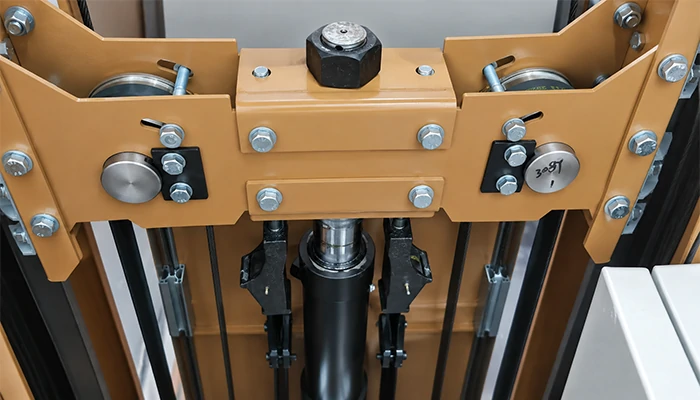
Hydraulic Home Elevator
Hydraulic home elevators utilize a hydraulic pump station and cylinder to generate pressure that extends and retracts the cylinder; steel ropes or belts then drive the elevator car upward. During descent, hydraulic pressure is released, allowing the car to lower under its own weight. For our export projects, we frequently use the “backpack-style” frame structure. Many clients, hearing that it is easy to modify, assume that the foundation requires no consideration at all—a point I will elaborate on later.
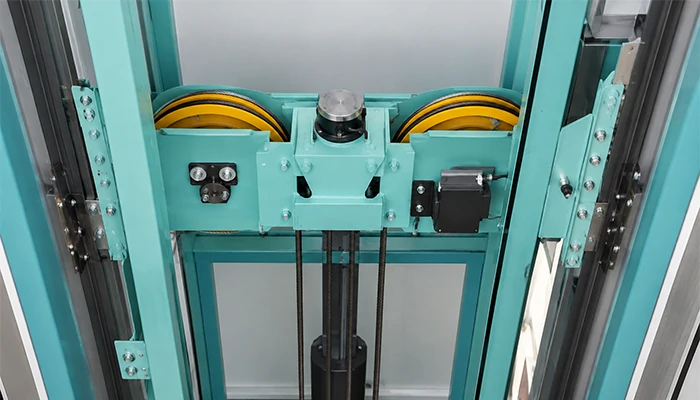
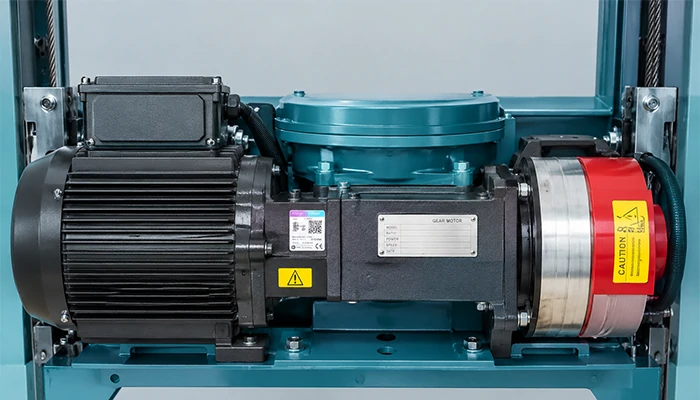
Traction Home Elevator
Traction home elevators utilize a traction machine to drive a traction sheave, relying on friction to move steel belts or wire ropes, while a counterweight balances the weight of the elevator car itself.
The mainstream design in the residential market today is the Machine-Room-Less (MRL) configuration; it eliminates the need for a dedicated machine room, as the counterweight is integrated directly into the shaft framework, making it widely used in new villa projects.
Key Comparison: Traction vs. Hydraulic Elevators for 2–4 Floors
The following serves as a general reference for residential projects involving villas or the renovation of existing homes (2–4 stories); please refer to the manufacturer’s actual product specifications for final parameters.
| Dimension | Hydraulic Home Elevator (Backpack Style) | Machine-room-less traction home elevator |
| Core driver | Hydraulic Cylinder + Pump Station | Traction machine + steel belt / steel wire rope + counterweight |
| Compatible floors | Optimal for 2–4 floors. | Suitable for floors 2- 7. |
| Pit Requirements | Requires a base depth of only 812mm; no need for a traditional deep pit. | Requires a standard shallow pit; renovations of older buildings may be subject to site constraints. |
| Top-level height requirements | Low requirements; suitable for attic spaces with low ceilings. | There are strict requirements regarding the top-level clear height. |
| Initial procurement cost | Low-rise projects offer a distinct price advantage. | The initial investment is higher for the same configuration. |
| Energy consumption performance | Energy consumption is relatively high during high-frequency operation. | Counterweight structure for greater energy efficiency during high-frequency use. |
| Noise level | The pump station generates operating noise during the upward travel of the elevator. | The unit operates with low noise, ensuring a quieter home environment. |
| Key Maintenance Focus Areas | Properly maintain hydraulic oil and seals to avoid the risk of oil leakage. | Steel belts / steel wire ropes, brakes, guide shoes |
| Suitability for renovation of older homes | Very high | Medium |
| Suitability for Newly Built Villas | Good | Very high |
| Load-bearing capacity | Capable of handling heavy loads. | Meets the vast majority of household load-carrying needs. |
Note: Do not draw immediate conclusions after reviewing the table; a model suitable for someone else’s project may not necessarily be appropriate for your specific site conditions.
Civil Engineering Conditions: The Biggest Pitfalls in Renovating Older Homes
The greatest advantage of the backpack-style hydraulic elevator is its adaptability to the renovation of existing homes. For many villas where interior work is already complete—and where no standard elevator shaft was originally provided and the attic ceiling height is insufficient—hydraulic models offer a viable solution thanks to their ultra-shallow pit requirements and “half-cabin” design options.
However, machine-room-less (MRL) traction elevators are different; they have strict standards regarding pit depth and top-floor overhead clearance. I have encountered many cases where initial discussions based on blueprints went smoothly, only for on-site inspections to reveal that the building’s structural work was substandard; this necessitated excavating the floor and raising the floor slab, causing both the project timeline and the budget to increase significantly.
Let me share a real-life scenario we encountered: many overseas clients looking to retrofit their facilities assume that because hydraulic models require minimal modification, they can completely disregard the building’s load-bearing capacity. Even if the base is only a dozen centimeters thick, it is still essential to verify the structural integrity regarding floor openings and frame load points; skipping this step creates safety risks.
Procurement Cost and Total Lifecycle Cost of Ownership
When preparing proposals, I’ve noticed that the vast majority of clients compare prices based solely on the cost of the equipment itself. However, since an elevator is a piece of equipment intended for over a decade of use, focusing only on the initial purchase price can easily lead to a miscalculation of the true cost.
For low-rise projects of two to three stories, the initial equipment investment for a hydraulic home elevator is more budget-friendly. If the elevator is used only occasionally by household members, the overall cost remains manageable. However, if it operates frequently on a daily basis, one must factor in the costs of electricity as well as maintenance expenses, such as the eventual replacement of seals and hydraulic fluid.
In contrast, machine-room-less traction home elevators entail a higher initial purchase cost for equivalent specifications. However, their counterweight design offers energy-saving advantages, and they are free from issues related to hydraulic oil aging or leakage. However, it places stringent demands on on-site installation techniques; if installation precision is inadequate, the subsequent failure rate will rise significantly.
Noise and Ride Experience
Both models of certified, compliant elevators ensure a comfortable ride for home use. The noise from hydraulic elevators primarily originates from the hydraulic pump station during upward travel; with proper sound insulation and vibration damping, noise levels can be kept very low. Downward movement relies on gravity and pressure release, resulting in quieter operation.
Mainstream home elevators utilizing permanent magnet synchronous traction technology offer superior overall noise performance and smooth start-stop operation, making them particularly suitable for households sensitive to noise.
Maintenance Highlights and Risk Warnings
For hydraulic models, the cylinders, seals, and hydraulic oil require regular inspection. With proper, scheduled maintenance, the likelihood of oil leakage is very low. However, seals are consumable components; as the service life increases, there is a risk of aging and leakage, necessitating regular inspection and replacement.
For MRL (Machine-Room-Less) traction models, routine inspections should focus on the wear of steel belts or ropes, as well as the operating condition of the brakes and guide shoes. While there are no risks associated with hydraulic fluid, it must be re-emphasized that the quality of installation directly determines the user experience during subsequent operation.
Safety and Export Certifications
Home elevators using either of the two drive systems can meet mainstream safety standards such as CE and ISO9001. Hydraulic elevators rely on hydraulic safety valves for descent protection and come standard with an Automatic Rescue Device (ARD) for power outages; traction elevators utilize speed governors and safety gears for overspeed protection and are likewise equipped with power-failure rescue devices.
Even with CE certification, the specific implementation requirements for residential elevators vary by country. We generally advise clients to verify local regulations for the target market during the early stages of a project; this prevents the need for costly rework caused by discovering non-compliance only after the design is well underway.
Hydraulic and Traction Home Elevators: Applications in Different Residential Projects
✅ It is more advisable to consider a hydraulic home elevator in the following situations:
- Renovation of existing 2–3 story homes or fully finished villas where large-scale excavation or structural work is undesirable;
- Low ceiling height in the attic or top floor, failing to meet the overhead clearance requirements for traction elevators;
- Low usage frequency, intended only for occasional family travel;
- Site conditions that do not allow for the excavation of a traditional deep pit.
✅ It is highly recommended to consider a machine-room-less traction home elevator.
1. For newly built villas, the elevator shaft and pit can be reserved during the structural construction phase in accordance with elevator specifications;
- The building has four or more floors;
- The elevator will see frequent daily use, including regular use by elderly family members;
- There is a desire to reduce long-term electricity costs and avoid maintenance concerns associated with the aging of hydraulic seals.
The above points serve only as a reference for model selection; the final plan must be based on data obtained from an on-site survey.
Key Procurement Points for B2B Clients (Architects / Contractors / Distributors)
For professionals working on overseas residential projects, product selection should not focus solely on specifications; the following points must be confirmed in advance:
- Verify whether product certifications comply with the regulatory standards of the target export markets;
- Obtain 2D/3D CAD drawings and equipment specifications from the manufacturer in advance to facilitate architectural design and drafting;
- For retrofit projects, conduct on-site surveys to verify floor load-bearing capacity, opening dimensions, and power supply conditions; do not finalize the equipment model based solely on architectural drawings;
- Confirm production lead times and spare parts supply channels; for overseas projects, verify the availability of remote technical support and the distributor’s after-sales support policies.
If your project requires a preliminary technical assessment, you can connect with our engineers.
Conclusion
Having worked on so many residential elevator projects, my takeaway is this: there is no single home elevator model that is suitable for every possible set of site conditions.
The advantages of hydraulic backpack-style elevators lie in their high adaptability for retrofitting existing buildings, minimal requirements for structural modifications, and cost-effectiveness for low-rise projects. Machine-room-less (MRL) traction elevators are better suited for applications involving greater floor heights and high usage frequency; they offer superior long-term energy efficiency and eliminate maintenance concerns associated with hydraulic oil.
When selecting a model, prioritize the building’s structural conditions and daily usage frequency, then compare the budget against the total lifecycle costs; avoid blindly favoring any single drive technology. Whether for a newly built villa or the renovation of an existing home, prioritize an on-site assessment before selecting the elevator type; always ensure the elevator is adapted to the house, rather than altering the house to force a fit for the elevator.
FAQ
Renovating an old two-story villa: which is more suitable—hydraulic or traction?
I receive this question almost every week. Before looking at the price, prioritize verifying the site’s structural conditions. If a standard pit cannot be constructed or the top-floor headroom is insufficient, you should focus on evaluating hydraulic “backpack” models; if the site meets all structural requirements, you can compare both types.
Is there a high risk of oil leakage with hydraulic home elevators?
These are products from reputable major manufacturers; with consistent, timely maintenance, the likelihood of oil seepage is very low. Seals are wear-and-tear items that require replacement once they reach the end of their service life; this is a standard part of routine maintenance.
Can a traction home elevator definitely be installed in an older house?
Not necessarily. Traction elevators have strict requirements regarding pit depth, top-floor height, and shaft dimensions. If the existing conditions in an older building do not meet these specifications, structural modifications will be required.
What modifications are required when replacing an existing hydraulic elevator with a traction elevator in an older project?
It is necessary to verify the internal shaft dimensions, pit depth, top-floor height, reserved space for the counterweight, floor load-bearing capacity, and power supply conditions. In the vast majority of cases, some degree of civil engineering modification is required; simply replacing the main unit is not feasible.
What information do I need to provide to the manufacturer to obtain an accurate proposal?
Number of floors, whether the building is new construction or a renovation, available on-site space, actual pit depth and top-floor height, estimated load capacity, target export country, and project application scenario.
Can you provide technical documentation and remote installation guidance to distributors?
Anter provides CAD drawings, complete specifications, and certification documents. For our partner distributors, we also offer online technical training and remote installation guidance, while also ensuring the supply of spare parts.
 English
  Arabic
  Vietnamese
  German
  Malay
Malay  Thai
Thai