
Shaftless home elevators are independently developed products that differ from traditional home elevators. They maximize the preservation of living space, making them the best auxiliary tool for simplifying life and improving mobility.
If you are considering installing a shaftless home elevator, the most pressing and challenging question is: how much does a shaftless home elevator cost?
To help you quickly find the answer and make a reasonable budget plan, this article will provide you with a detailed introduction to the price and influencing factors of shaftless home elevators.
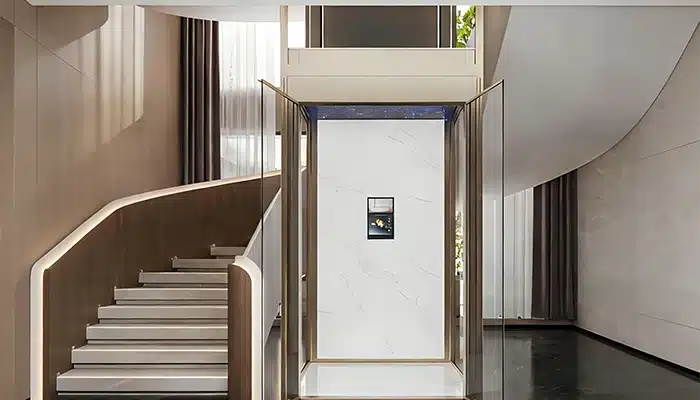
What Is a Shaftless Home Elevator?
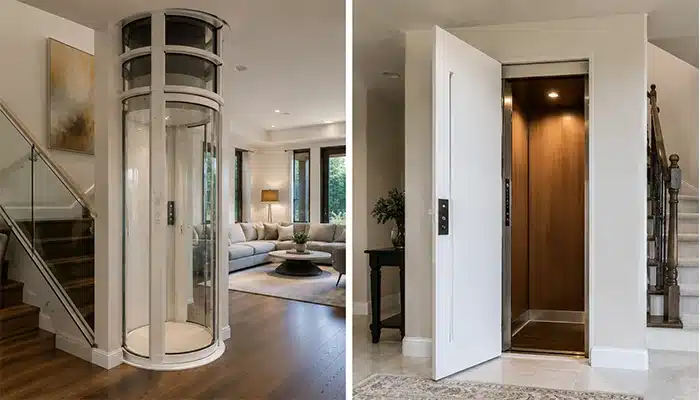
Shaftless home elevators abandon the traditional concrete shaft and instead use an integrated steel structure as the shaft body. It does not require large-scale civil engineering to construct shafts or deep pits, and can be installed against walls, in the middle of staircases, or in corners.
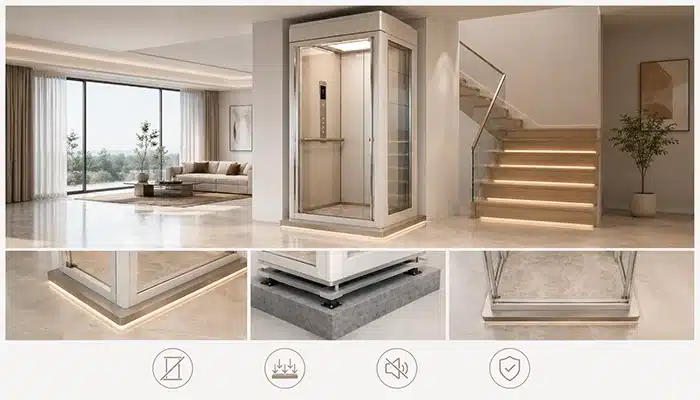
How Does a Shaftless Elevator Work?
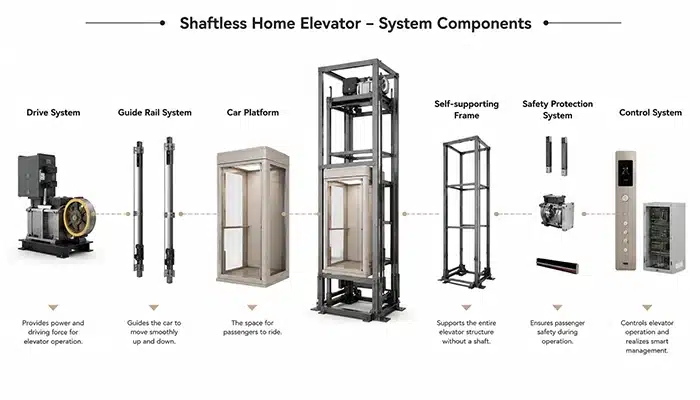
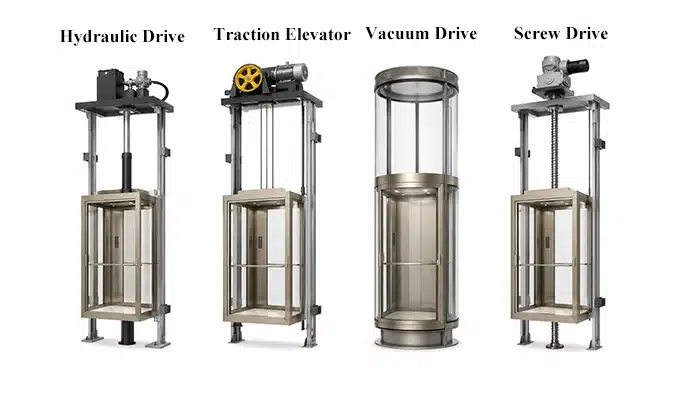
A shaftless home elevator consists of a drive system, a guide rail system, a car platform, a self-supporting frame, a safety protection system, and a control system. During operation, the drive system generates power to propel the car platform up and down along the guide rails. Common drive systems for shaftless home elevators include: hydraulic drive, traction drive, screw drive, and vacuum drive.
Who Is It Best For?
Shaftless home elevators are suitable for families with elderly members, wheelchair users, and members with mobility impairments. This device can help them overcome the obstacle of stairs, improve mobility, and reduce the risk of falling.
At the same time, it is also suitable for duplex and villa owners. It is a mid-to-high-end customized product that combines practicality and aesthetics. When it is perfectly integrated into your decoration style, it can also enhance the sense of luxury and intelligence of the residence.

Average Shaftless Home Elevator Cost in 2026
Globally, the following is the average price of shaftless home elevators in 2026.
| Product Level | Average Price Range |
| Economy | 5000$-10000$ |
| Standard home use | 10000$-18000$ |
| Mid-to-high-end customized | 18000$-35000$ |
| High-end imported | 35000$-70000$ |
The above is the average price range for shaftless home elevators, excluding installation costs. However, the final price you pay will depend on basic information about the residential site (such as the number of floors, reserved dimensions), the expected number of people, the type of elevator, customization options, and the degree of structural modifications required for installation.
What Factors Affect Shaftless Home Elevator Cost?
Number of Floors
Starting from the second floor, the price of a shaftless home elevator increases by 12%-18% for each additional floor. Because the additional floor requires a separate door system, and the guide rails need to be extended, along with the length and thickness of the integrated frame. At the same time, the drive system also needs to be upgraded, such as by thickening the screw and increasing the size of the hydraulic pump station.
Cabin Size
The larger the car size of a shaftless home elevator, the higher the price. However, this is not simply due to the use of more materials; it also includes the increased costs of designing, manufacturing, and transporting the entire elevator system.
The standard size of a shaftless home elevator is usually 800*800mm. If you want to make a car size of 900*1200mm, the price will increase by 20%; if you want to make a car size of 1200*1400mm suitable for wheelchair access, the price will increase by 50%.
Load Capacity
Changes in load capacity directly affect the structure and drive system of shaftless elevators. The load capacity of shaftless home elevators ranges from 250 kg to 500kg+. The 250kg version is the standard model. To increase the load capacity, the drive system needs to be enhanced, and a higher-grade welding process is required for thicker steel. At the same time, the safety system is upgraded, and the guide rails and transmission components are thickened and reinforced.
Drive System
The difference in drive system is one of the biggest factors that causes price differences between shaftless home elevators.
Among the four drive systems, hydraulic elevators are the cheapest, while traction elevators, as a representative of mid-to-high-end home elevators, are more expensive than hydraulic drives. Due to the high precision requirements, screw elevators rank second in price. The most expensive type is the vacuum elevator, which is limited by issues such as technological monopoly and brand premium.
Customization Options
The customization options for shaftless home elevators are as follows:
Door Types: “Influencer-style” Doors, Center-opening Doors, Side-opening Doors, Manual Sliding Doors, Electric Doors, Bi-fold Doors
Car Materials: Steel Plate, Glass, Stainless Steel, Wood Veneer
Colors and Finishes: A wide range of colors, plus specialized finishes such as custom spray painting, wood grain transfer, champagne gold, titanium gold, etching, and other processes.
Functions: Remote control, app control, voice prompts, automatic lighting, etc.
Frameworks: Light-duty Frameworks and Heavy-duty Frameworks
Dimensions and Load Capacity: Customized based on actual space and requirements.
The more customized features a shaftless home elevator project involves—and the higher its specifications—the more expensive the price will be.

Shaftless Elevator vs Traditional Home Elevator Cost
| Project | Shaftless Home Elevator | Traditional Home Elevator |
| Average Equipment Cost | $8000-$18000 | $15000-$30000 |
| Civil Engineering Costs | $0 ~ $2,000 | $8,000 ~ $15,000 |
| Maintenance Costs | $150 ~ $300 | $300 ~ $600 |
| Installation Cost | $2,500–$3,000 | $6,000–$7,000 |
| Installation Time | 1–3 days | More than 10 days |
| Space occupied | Small | Big |
| Total Price Range | $9,500–$22,000 | $19,000–$40,000 |
Additional Costs Homeowners Often Forget

Floor Slab Openings and Reinforcement
Shaftless home elevators require an opening to be cut into the floor slabs—equal in size to the dimensions of the elevator—to ensure that the elevator can travel vertically between different floors. Typically, the cost of cutting openings in wood-framed floor slabs is lower than that for concrete floor slabs.
Furthermore, elevator installation imposes specific load-bearing requirements on the floor slabs; if a professional assessment determines that the structure does not meet residential load-bearing standards, reinforcement work must be completed prior to the installation of the elevator.
Electrical Renovation
Electrical renovations involve two components of cost. The first part consists of the costs incurred for independent circuit wiring. Shaftless home elevators are high-power electrical appliances; sharing a circuit with household devices such as refrigerators, televisions, and vacuum cleaners can lead to issues such as voltage instability, erratic elevator operation, appliance damage, and circuit tripping.
Part Two covers the cost of the distribution box upgrade. This portion of the costs is primarily incurred in older houses. Many older homes were not designed with the use of high-power appliances in mind; consequently, their electrical capacity is insufficient and requires upgrading. Furthermore, many older distribution boxes do not meet modern electrical standards and require retrofitting.
Licensing and Acceptance
In countries such as the United States, Canada, and Australia, the installation of shaftless home elevators requires obtaining building and electrical permits issued by the relevant local government authorities.
Furthermore, upon completion of the installation, an inspector from the building or electrical permitting authority must conduct a final inspection. The devices may only be put into use after it has successfully passed this inspection.
Renovation Restoration
During the installation process, some unavoidable damage to the floor slab occurs; therefore, to maintain the aesthetic appeal of the home’s interior, repairs are required. The repairs include: floor patching, ceiling patching, wall patching, and painting.
Ongoing Maintenance Costs
Elevators require regular maintenance to ensure a longer service life. We recommend simple routine maintenance, such as cleaning elevator surfaces and removing surrounding obstructions, and professional maintenance once a year. Professional maintenance services include replacing severely worn parts, systematically identifying and eliminating safety hazards, and performing lubrication and servicing.
How to Reduce Shaftless Home Elevator Costs
Select Standard Elevator Type and Specifications
Choosing standardized elevators can reduce costs. Most factories mass-produce standard ladders, which have lower unit manufacturing costs and maintain a reserve of standard ladders, giving them more room for negotiation.
Secondly, standardized elevator construction solutions are simple and mature, do not include separate design fees, and have short installation cycles, low rework rates, and low labor costs.
Civil Engineering and Installation Cost Control
Provide the manufacturer with accurate information about the dimensions of the reserved space and the height of each floor so that the elevator can be fully adapted and installed after it arrives.
In addition, if you are importing elevator equipment from abroad, it is recommended to find an installation team locally, as labor costs are lower and installation time is shorter.
Finally, please note that blindly increasing the opening size in pursuit of an extra-large car will result in high costs for floor reinforcement and repair.
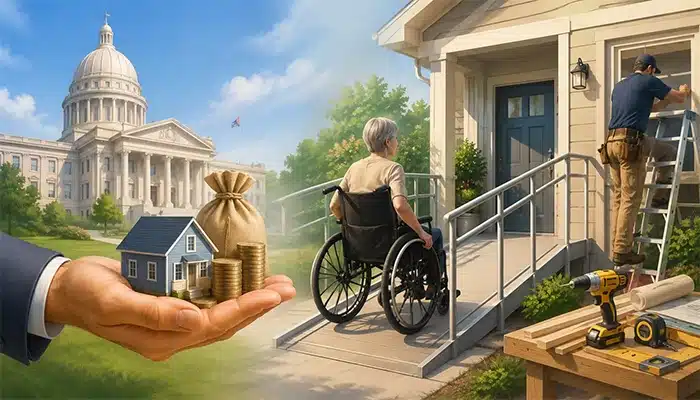
Government Subsidies and Accessibility Renovation Grants
Some countries, such as the United States, Canada, Italy, and France, offer subsidies for shaftless home elevators used for medical rehabilitation purposes. It includes the U.S. VA Veterans’ Home Accessibility Modification Grant, the UK’s Disabled Facilities Grant, Canada’s Home Accessibility Tax Credit, and Australia’s NDIS + AT-HM Scheme…..
Hurry up and visit your local government’s official website to search for any eligible subsidy programs!
Why Homeowners Choose Anter Shaftless Home Elevators
Anter‘s experts in shaftless home elevators would be happy to provide you with a free installation plan and quotation. We can communicate directly with your architect or installation team to ensure that we design and manufacture a shaftless home elevator that perfectly meets your specific needs.
We own independent factories and showrooms in China, where we showcase 20 of the most common residential elevator models found on the market; you are welcome to visit and experience them firsthand at any time.
If you have any questions, please contact us. We are online 24 hours a day to answer your questions.
Faq
What are alternatives to a shaftless home elevator?
Alternatives to shaftless home elevators include vertical platform lifts and stair lifts. If your home has enough space to build a concrete shaft, a traditional home elevator with a shaft is also a good option, offering greater comfort.
What happens during a power outage?
Shaftless home elevators are typically equipped with a backup power supply. In the event of a sudden power outage, the elevator switches to a backup power supply within milliseconds to ensure that the car comes to a stop at the nearest floor.
Is a shaftless home lift better than a stair lift?
For wheelchair users, individuals with mobility impairments, and those aging in place, a shaftless home elevator is superior to a stairlift—offering simpler and more convenient operation.
How much space does a shaftless home elevator need?
| Type | Minimum footprint (including frame) | Maximum footprint (including frame) |
| Screw-type | 1.1 m × 1.1 m | 1.8 × 1.8m |
| Traction Type | 1.2m*1.2m | 2m*2m |
| Hydraulic | 1m*1m | 2.2m*2.2m |
| vacuum | 600*700m | 900m-1000m |
Are shaftless home elevators safe?
The safety of shaftless home elevators is guaranteed by multiple safety devices, comparable to commercial elevators.
Shaftless home elevators manufactured by professional companies typically include overspeed limiters, fall arrest safety clamps, emergency power supplies for power outages, automatic leveling systems during power outages, anti-pinch safety touch panels, and anti-pinch light curtain sensors, which can effectively prevent potential dangers.
 English
  Arabic
  Vietnamese
  German
  Malay
Malay  Thai
Thai