
When working on overseas villa projects, I am frequently asked this question: how exactly do residential elevators achieve stable operation?
Most owners are primarily concerned with ride comfort, appearance, and price, and rarely delve into the details of the drive system. However, for those of us who work on the front lines—handling surveys, installation, and after-sales maintenance—it is crucial to understand the operating principles of home elevators. We have encountered many clients who, due to a lack of such knowledge, chose the wrong drive system; this subsequently led to issues like high energy consumption, spatial incompatibility, and difficulties with maintenance.
To avoid the aforementioned issues, this guide breaks down the operating logic of home elevators in accessible, easy-to-understand terms, serving as a reference for your initial project assessment and planning.
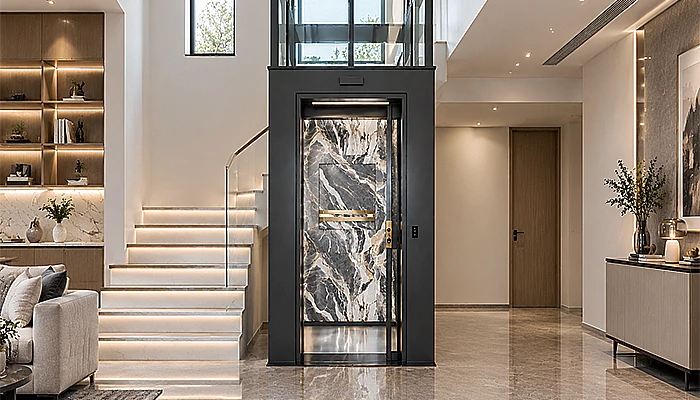
Basic Principles of Residential Elevators
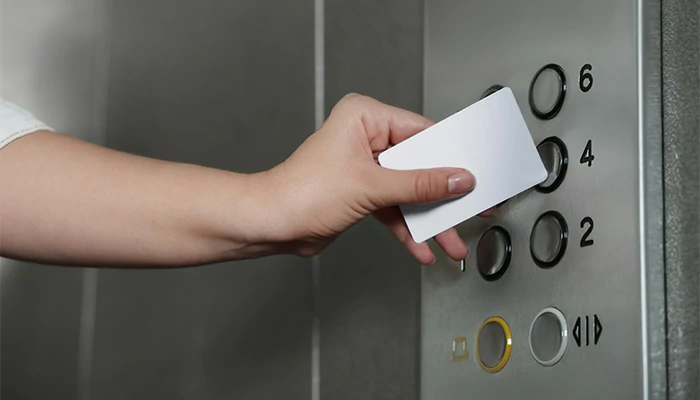
The elevator types most commonly used in villa projects today fall into two categories: traction and hydraulic. Although they operate on different drive principles, their basic control processes are essentially the same. When you press the button for your target floor—whether from inside the elevator car or at a landing call panel—the signal is transmitted to the control cabinet. Rather than initiating movement immediately, the control system first performs a comprehensive safety self-check. It verifies that the landing and car door locks, limit switches, safety circuits, and braking system are all functioning correctly; only then does it issue an operating command to the drive unit.
The elevator car moves along precision guide rails on both sides, with a control system that adjusts speed in real time to ensure smooth starts and stops—eliminating jolts or impacts—and locks the car securely in place upon arrival at a floor.
In short: the drive system provides the power for lifting and lowering, the guide rails ensure the car stays on track, the control cabinet acts as the brain of the entire system, and various safety devices serve as the ultimate safeguard.
Work Principle of Traction Home Elevators (The Predominant Model for Villas)
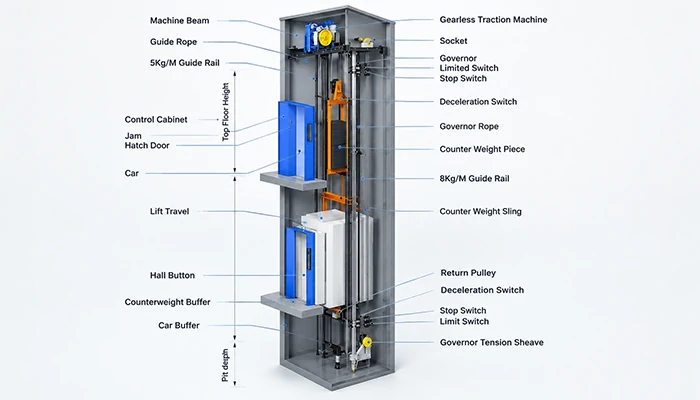
Traction elevators are the model we most frequently recommend for high-end villa projects; they share the same fundamental structure as commercial passenger elevators. They have been specifically adapted for residential use with a more compact design—most versions are “machine-room-less,” eliminating the need for a dedicated machine room.
The core component of a traction home elevator is the permanent-magnet synchronous gearless traction machine, which features a traction sheave wrapped with steel belts or wire ropes. One end of these ropes is attached to the elevator car, while the other is connected to a counterweight. The weight of the counterweight is precisely calculated and calibrated to balance the mass of the car itself plus half of its rated load—a principle similar to that of a seesaw. As the elevator car moves upward, the counterweight moves downward; conversely, as the car moves downward, the counterweight moves upward. The motor does not need to support the entire weight of the car and its passengers throughout the journey; it only needs to overcome the weight difference between the two sides. This is the fundamental reason why traction elevators operate quietly, consume less energy, and offer superior long-term stability.
Furthermore, throughout the entire travel, T-shaped guide rails on both sides constrain the elevator car, preventing it from swaying laterally; meanwhile, the braking system locks the traction sheave during startup, stopping, and floor-leveling. The steel belt tension and the vertical alignment of the guide rails must be repeatedly calibrated using specialized tools, as the level of precision directly impacts both the ride experience and the service life of the components.
Work Principle of Hydraulic Home Elevators (An Ideal Choice for Retrofitting in Spaces with Height Constraints)
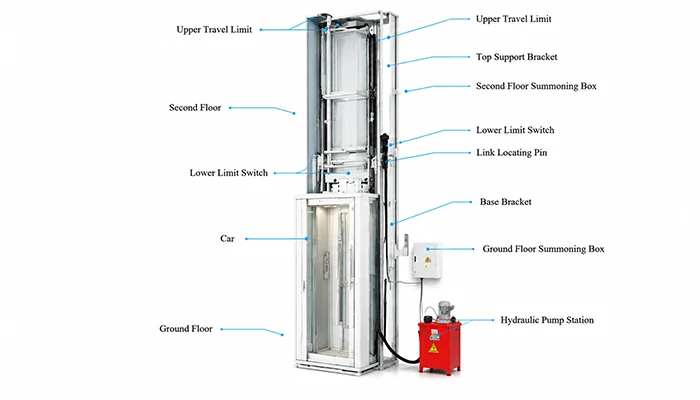
Hydraulic elevators are driven by hydraulic power, with core components including a hydraulic pump station, cylinders, hydraulic piping, and a control valve assembly. They are particularly well-suited for renovation projects in older villas where the top-floor height is insufficient or the overhead space in the elevator shaft is limited.
Ascent phase: The pump station motor drives the hydraulic pump, which pressurizes the hydraulic oil and delivers it into the hydraulic cylinder. The plunger extends upward, pushing the elevator car directly to make it ascend. Upon reaching the target floor, the pump stops supplying oil, the hydraulic pressure is locked, and the elevator car remains in position.
Downward phase:The motor does not need to perform continuous work; instead, the control valve opens, allowing hydraulic fluid to flow back into the reservoir, and the car descends at a steady, slow speed under its own weight.
The advantage of hydraulic elevators is that they have low overhead height requirements, and the main unit can be positioned outside the elevator shaft. Their drawbacks are equally clear: they consume more energy during long-term operation compared to traction-type elevators; fluctuations in oil temperature can slightly affect the smoothness of operation; and the hydraulic system requires regular inspection to prevent the risk of oil leaks.
How The Integrated Safety Protection System Works in Synchronization?
Many customers think that safety devices are independent accessories. In fact, they are fully linked with the operating system and are also an irreducible part of the passenger elevator.
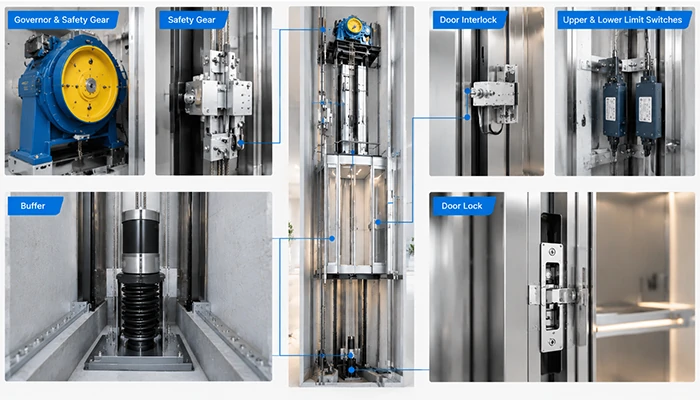
The combination of a speed governor and safety gear serves as the primary protection against falls. Should the elevator car begin to descend at an excessive, unintended speed, the speed governor is immediately triggered, engaging the safety gear to clamp onto the guide rails and bring the car to a firm, secure stop. Additionally, buffers are installed at the bottom of the elevator shaft to provide a final, fail-safe layer of protection for extreme scenarios.
Each landing door and elevator car door is equipped with an interlocking locking circuit; if the doors are not fully closed and locked, the elevator remains locked and cannot be started. Additionally, upper and lower limit switches are installed to prevent the car from overtraveling to the top or bottom of the shaft.
These safety devices are standard features for both traction and hydraulic home elevators, and they are also key items subject to rigorous verification during the certification and audit process for overseas projects.
The Importance of Understanding How Home Elevators Work for Model Selection
Understanding the operational logic is not for the purpose of performing elevator repairs yourself, but rather to avoid pitfalls when selecting a model.
If a home sees frequent use or is occupied by elderly residents, a traction-type residential elevator should be the top choice, as it offers superior advantages in terms of long-term energy consumption, stability, and ease of maintenance.
If the layout has inherent limitations—such as insufficient ceiling height on the top floor, which prevents it from meeting the shaft requirements for a traction elevator—then a hydraulic system should be evaluated as an alternative.
A word of caution: understanding the underlying principles does not mean you are qualified to assemble and commission the system yourself. All system-level commissioning and safety verification must be performed by a certified professional team; attempting to DIY a passenger elevator carries extreme safety and compliance risks.
Conclusion
In one sentence: Traction elevators rely on a counterweight for balance and the frictional drive of a traction sheave to achieve vertical movement, while hydraulic elevators rely on hydraulic pressure to lift the car for upward and downward travel.
Both options come with complete control loops and safety protection systems; neither is inherently better or worse. The best choice depends primarily on the dimensions of your villa’s elevator shaft, the ceiling height of the top floor, your budget, and the frequency of daily use. The most prudent approach is to select a drive type based on the findings of an on-site survey.
If you are still struggling with your choice of a home elevator, feel free to contact us directly. Anter has a team of professional technicians who can provide expert advice and reliable products tailored to the specific requirements of your project.
FAQs
Are the steel belts used in traction elevators prone to breaking?
Qualified polyurethane-coated steel belts undergo fatigue testing and incorporate a safety margin; however, their tension and wear status must be checked periodically. Always choose a complete unit from a reputable manufacturer, and avoid systems assembled from disparate, individual components.
Do hydraulic elevators always leak oil?
Using legitimate, complete machine units along with high-quality hydraulic cylinders and piping can significantly reduce the likelihood of oil leaks. However, as the hydraulic system is subject to wear and tear, it requires regular maintenance and inspection; it is not possible to achieve a “zero-maintenance” state for the entire lifespan of the equipment.
Where is the main unit of a machine-room-less (MRL) traction elevator located?
The main unit is integrated into the space along the side of the upper part of the elevator shaft, eliminating the need for a separate machine room; this saves interior floor space and makes it a popular choice for villa renovations.
How long do residential elevators last ?
With proper installation, standard usage, and regular maintenance, a home elevator can remain in service for 20–30 years, or even longer.
What does a residential elevator cost?
According to the latest data for 2026, the average price for a residential elevator worldwide ranges from $5,000 to $60,000. Costs are determined by the number of floors—for instance, a 2-story installation will differ in price from one spanning 3 to 4 floors. Furthermore, the final price varies based on the chosen drive mechanism, configuration, and style.
How long does it take to install a residential elevator?
The average installation time for a home elevator ranges from 2 to 10 days, though the exact duration depends on the elevator type, its configuration, and the specific conditions at the installation site. For instance, the installation of a high-end, circular panoramic elevator typically requires ten days or more.
How much space is needed for a residential elevator?
A home elevator typically requires an installation space of approximately 1–2.5 square meters. However, the exact requirement depends on the type of elevator and its specific configuration. If you have limited space, we offer more compact models that can be installed in an area of less than 1 square meter—with no need for a dedicated elevator shaft or a deep pit.
How much electricity does a home elevator use?
The power consumption of a residential elevator is roughly equivalent to that of a large household appliance, ranging from 0.02 to 0.15 kWh per operation; however, the exact figure depends on the motor and drive system used by the manufacturer, as well as the specific technical specifications of the elevator.
What are the power requirements for a typical home elevator system?
The electrical specifications for home elevators typically include the following:
Power supply voltage: 220–240 V (single-phase) or 380–415 V (three-phase)
Frequency: 50 Hz or 60 Hz
Motor power: Approximately 2.2–5.5 kW
Dedicated circuit.
Our home elevator systems can be configured to suit your specific region and requirements, ensuring a perfect fit for your project.
 English
  Arabic
  Vietnamese
  German
  Malay
Malay  Thai
Thai